Data Annotation Explained: The Invisible Engine Behind Every AI Model
Cover Image
Every time a radiologist draws the boundary around a tumor in a medical scan, they're teaching an AI what cancer looks like. Every time a linguist tags the sentiment of a customer support ticket as "frustrated," they're shaping how a model understands human emotion at scale.
These moments look mundane. They look like grunt work. But annotation is, without exaggeration, the most consequential step in any AI system's development.
Data annotation is the process of labeling raw data — images, text, audio, video — so that machine learning models can learn from examples rather than rules. What most explainers skip: annotation isn't a preprocessing step. It's a capability decision. The quality of your labels determines the ceiling of your model's performance, regardless of how sophisticated your architecture is.
What Data Annotation Actually Does
Models don't understand the world. They learn statistical patterns between inputs and outputs. Annotation creates those outputs — the ground truth that a model is trained to predict.
For supervised learning, you need labeled examples: "this image contains a pedestrian," "this sentence is negative sentiment," "this audio segment is speech, not background noise." Without that signal, the model has nothing to optimize toward.
The relationship between annotation quality and model quality is direct:
- Label errors become prediction errors at test time. A model trained on mislabeled data learns the mislabeling.
- Coverage gaps create blind spots. If your training data doesn't include edge cases, the model fails silently on them in production.
- Inconsistent guidelines produce noisy labels. When five annotators interpret the same instruction differently, the model learns the noise.
Modern LLMs like GPT-4 and Llama 3 were trained on trillions of tokens, but the RLHF (Reinforcement Learning from Human Feedback) fine-tuning that makes them useful and safe was done on carefully annotated preference data — human raters comparing model outputs and labeling which was better. That annotation work is why these models follow instructions rather than just completing text.
The Main Types of Data Annotation
Image and Video Annotation
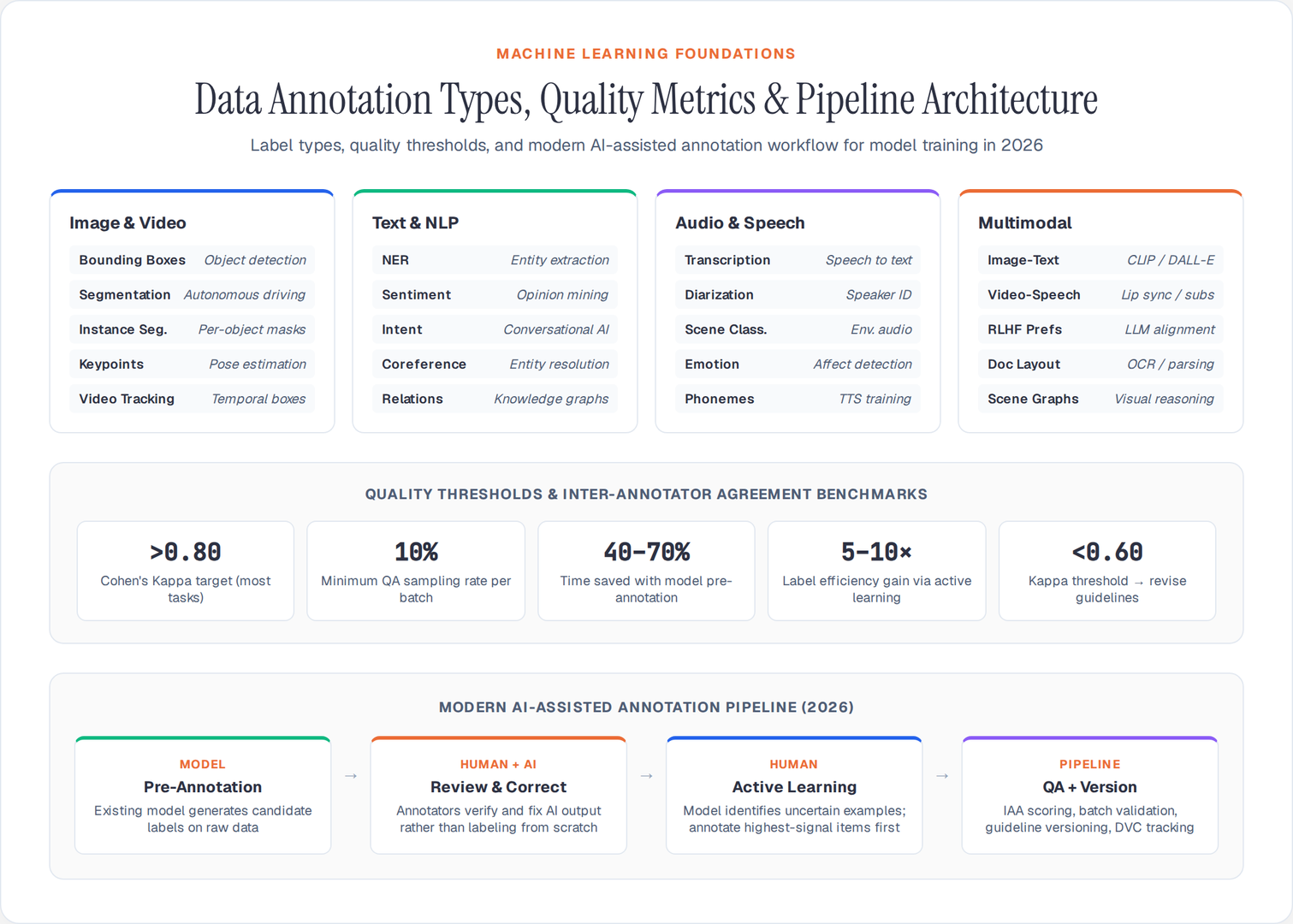
Bounding boxes: Rectangles drawn around objects. Used for object detection models. Fast to annotate, but only captures location, not exact shape.
Semantic segmentation: Pixel-level labeling where every pixel is assigned a class. Required for autonomous driving (road, pedestrian, sky, vehicle must all be identified per pixel). Labor-intensive — a single image can take 20–60 minutes to annotate properly.
Instance segmentation: Like semantic segmentation but distinguishes between individual objects of the same class. "This pedestrian" vs "that pedestrian" rather than "pedestrian pixels."
Keypoint annotation: Labeling specific points on objects (joints on human skeletons, landmarks on faces). Used for pose estimation and facial recognition.
Video annotation: Tracks objects across frames — bounding boxes that move consistently as an object moves through a video. Requires temporal consistency checks that image annotation doesn't.
Text Annotation
Named Entity Recognition (NER): Labeling entity types in text — persons, organizations, locations, dates, monetary values. Foundational for information extraction pipelines.
"Apple CEO Tim Cook announced at [LOCATION: Cupertino] that [ORG: Apple]
would release the [PRODUCT: iPhone 18] in [DATE: Q3 2026]."
Sentiment analysis: Classifying text as positive, negative, or neutral. More nuanced implementations add emotion categories (anger, joy, disgust) or aspect-level sentiment (positive about product quality, negative about shipping speed).
Intent classification: Labeling what a user is trying to accomplish. Critical for conversational AI: "Book me a flight" (booking intent) vs "What flights are available" (query intent) require different system responses.
Coreference resolution: Identifying when different words refer to the same entity. "The company announced its earnings. It beat expectations." — annotating that "It" refers to "The company."
Relation extraction: Labeling relationships between entities. "[ORG: OpenAI] [ACQUIRED] [ORG: Rockset]" — structured relationship data extracted from unstructured text.
Audio Annotation
Speech transcription: Converting audio to text. Requires capturing hesitations, speaker diarization (who said what), and handling overlapping speech.
Acoustic scene classification: Labeling environmental audio as "restaurant," "street traffic," "office," etc. Used for environmental awareness in mobile AI systems.
Speaker identification: Labeling audio segments by speaker identity. Foundation for voice recognition and speaker separation systems.
Multimodal Annotation
Image-text alignment: Pairing images with descriptive captions. CLIP, DALL-E, and image-to-text models were trained on hundreds of millions of such pairs. The quality of the pairing directly affects the model's ability to understand visual-language relationships.
Video-speech alignment: Matching speech content to video events. Used in training models for lip reading, automatic video subtitling, and audio-visual understanding.
Why Most Annotation Projects Fail
Annotation failure is almost never a tooling problem. It's a process problem.
Annotation guidelines aren't specific enough. "Label negative sentiment" sounds clear until an annotator encounters sarcasm, mixed sentiment, or domain-specific language that doesn't fit the category. Guidelines need decision trees for edge cases, worked examples for ambiguous categories, and explicit handling of "none of the above" scenarios.
Inter-annotator agreement isn't measured. If two annotators would label the same item differently, your labels are noisy. Cohen's kappa should be measured regularly and fed back into guideline refinement. Target kappa above 0.8 for most tasks; below 0.6 means the guidelines need work, not more annotations.
Domain expertise is treated as optional. Medical imaging annotation by non-clinicians produces labels that look correct but are clinically meaningless. Annotation tasks that require domain knowledge need domain experts, not just careful generalists.
Data pipelines have no quality feedback loop. Annotations are produced, sent to training, and problems show up later in model evaluation. A validation step that samples a percentage of completed annotations and measures quality before they enter training catches errors at the source.
Volume is optimized over quality. Cost-per-label metrics drive annotator behavior toward speed. Per-label cost incentivizes rushing. Better metrics: rejection rate, inter-annotator agreement score, and error detection rate.
AI-Assisted Annotation in 2026
The annotation pipeline has changed significantly. Pure human annotation is no longer the default approach for most tasks.
Model-assisted pre-annotation: Run an existing model on the raw data to generate candidate labels, then have humans review and correct rather than label from scratch. Reduces annotation time by 40–70% on tasks where a reasonable base model exists. Accuracy depends heavily on pre-annotation model quality.
Active learning: Instead of annotating randomly, use the model to identify which examples it's most uncertain about and prioritize annotating those. The model learns faster per label — typically requires 5–10x fewer labels to reach the same accuracy as random sampling.
import numpy as np
from sklearn.svm import SVC
from sklearn.preprocessing import StandardScaler

def active_learning_uncertainty_sampling(
    model,
    unlabeled_pool: np.ndarray,
    n_select: int = 100,
) -> np.ndarray:
    """Select the most uncertain examples from unlabeled pool for annotation."""

    # Get probability estimates for each class
    probas = model.predict_proba(unlabeled_pool)

    # Uncertainty = 1 - max probability (least confident sampling)
    uncertainty_scores = 1 - probas.max(axis=1)

    # Return indices of top-N most uncertain examples
    top_indices = np.argsort(uncertainty_scores)[-n_select:]

    return top_indices
LLM-based annotation: Use GPT-4 or Claude to annotate at scale with a detailed rubric. Works well for text tasks (sentiment, intent, summarization quality). Cheaper than crowdsourced human annotation, but outputs need validation — LLM labels inherit LLM biases.
RLHF pipelines: Constitutional AI and RLHF use iterative loops between model outputs and human preference ratings. The annotation task shifts from "label this data" to "compare these two outputs and say which is better." Simpler judgment task, more scalable format.
Annotation Tooling Landscape in 2026
| Tool | Best For | Model-Assisted | Pricing |
|---|---|---|---|
| Label Studio | Open-source, flexible | Yes (ML backends) | Free / Enterprise |
| Scale AI | Enterprise, complex tasks | Yes | Custom |
| Roboflow | Computer vision | Yes (auto-label) | Freemium |
| Prodigy | Developer-focused, NLP | Yes (active learning) | $490 one-time |
| Labelbox | Large teams, compliance | Yes | Custom |
| V7 Labs | Medical / life sciences | Yes | Custom |
For small teams or researchers: Label Studio is the standard open-source choice. Runs locally, supports all annotation types, integrates ML model backends for pre-annotation.
For production pipelines at scale: Scale AI and Labelbox handle workforce management, quality assurance, and compliance requirements that become necessary above a few thousand examples.
What Good Annotation Infrastructure Looks Like
Well-structured annotation projects share these properties:
Versioned annotation guidelines. Guidelines change as edge cases surface. Version control on guidelines means you know which version an annotator was using when they labeled a batch, and you can re-annotate if guidelines changed significantly.
Staged quality review. Random sampling (10% of batches reviewed), adjudication layers for disagreements, periodic calibration sessions where annotators label the same examples to measure drift.
Feedback loops to annotators. Annotators who don't know when they're wrong produce more errors. Regular feedback, calibration reports, and guideline updates based on actual error patterns improve quality over time.
Separate test set management. Test sets should be annotated by different people than training data, under stricter conditions, with higher inter-annotator agreement requirements. This prevents test set contamination where annotators learn the "right answers" over time.
Conclusion
Data annotation is engineering work, not clerical work. The decisions made in annotation guidelines — what counts as an entity, how to handle ambiguous cases, what level of agreement is acceptable — directly translate into model capability and failure modes.
As AI-assisted annotation matures, the human role shifts from production annotator to annotation system designer: writing guidelines, measuring quality, training annotators, and building the feedback loops that keep label quality high as requirements evolve.
The invisible work that makes AI visible is getting more complex, not less. Models that appear to work often fail because of annotation decisions made months earlier. Models that appear to fail often improve substantially from annotation quality fixes alone. Understanding that relationship is the starting point for any serious ML system.
Author

Author