6 Data Collection Methods for Generative AI in 2026
Training data determines what a generative AI model can and can't do. The architecture, parameter count, and fine-tuning approach all matter — but they operate on the data you feed them. Bad data produces capable-looking models that fail in production. Good data at the right scale produces models that actually work.
This covers six data collection methods, what they're actually good for, technical implementation, and where each one breaks down in practice.
1. Web Scraping
Web scraping remains the dominant method for assembling large text corpora. The open web contains more domain-specific content than any other source — technical documentation, forum discussions, product descriptions, news archives, scientific preprints.
What makes scraped data useful for AI training:
Quality varies enormously by source. The Common Crawl corpus (used to train most large language models) contains everything from academic papers to spam sites. For domain-specific fine-tuning, you want targeted scraping of high-signal sources.
Implementation for training data collection:
import httpx
import asyncio
from bs4 import BeautifulSoup
from dataclasses import dataclass, asdict
import json
import hashlib

@dataclass
class TrainingDocument:
    url: str
    title: str
    text: str
    domain: str
    word_count: int
    content_hash: str

async def scrape_for_training(urls: list[str]) -> list[TrainingDocument]:
    documents = []

    async with httpx.AsyncClient(
        headers={"User-Agent": "Mozilla/5.0 (compatible; research-bot/1.0)"},
        timeout=20.0,
    ) as client:
        for url in urls:
            try:
                response = await client.get(url)
                if response.status_code != 200:
                    continue

                soup = BeautifulSoup(response.text, 'html.parser')

                # Remove boilerplate elements
                for tag in soup(['nav', 'footer', 'aside', 'script', 'style', 'header']):
                    tag.decompose()

                title = soup.find('h1')
                title_text = title.get_text().strip() if title else ''

                # Extract main content text
                main = soup.find('main') or soup.find('article') or soup.body
                text = main.get_text(separator='\n', strip=True) if main else ''

                # Filter low-quality documents
                word_count = len(text.split())
                if word_count < 100:  # Skip thin content
                    continue

                doc = TrainingDocument(
                    url=url,
                    title=title_text,
                    text=text,
                    domain=httpx.URL(url).host,
                    word_count=word_count,
                    content_hash=hashlib.sha256(text.encode()).hexdigest(),
                )
                documents.append(doc)

                await asyncio.sleep(0.5)  # Respect rate limits

            except Exception as e:
                print(f"Failed {url}: {e}")

    return documents
Data quality concerns for AI training:
- Deduplication is essential. Near-duplicate content causes the model to overfit to repeated patterns. Use MinHash or SimHash for approximate deduplication at scale.
- HTML artifacts (navigation text, cookie consent boilerplate, footer menus) pollute training data. Clean aggressively before using.
- License and copyright considerations apply to scraped content used for commercial model training.
2. API-Based Collection
APIs return structured, documented, version-stable data — the cleanest input for training pipelines. Most major platforms (Twitter/X, Reddit, GitHub, Wikipedia) offer APIs specifically because scrapers create infrastructure load.
Advantages over scraping:
- Structured JSON/XML rather than HTML-parsed text
- Consistent schema across requests
- Rate limits defined and documented
- Legal clarity on data usage rights (varies by API terms)
Example: GitHub API for code training data
import httpx
import asyncio
from typing import Generator

GITHUB_TOKEN = "ghp_..."  # Personal access token

async def collect_code_repositories(
    language: str,
    min_stars: int = 100,
    max_repos: int = 1000,
) -> Generator:
    """Collect high-quality code repositories for training."""

    headers = {
        "Authorization": f"token {GITHUB_TOKEN}",
        "Accept": "application/vnd.github.v3+json",
    }

    collected = []
    page = 1

    async with httpx.AsyncClient(headers=headers) as client:
        while len(collected) < max_repos:
            # Search for high-quality repositories
            response = await client.get(
                "https://api.github.com/search/repositories",
                params={
                    "q": f"language:{language} stars:>={min_stars}",
                    "sort": "stars",
                    "per_page": 100,
                    "page": page,
                }
            )

            data = response.json()
            if not data.get("items"):
                break

            for repo in data["items"]:
                # Fetch README for context
                readme_res = await client.get(
                    f"https://api.github.com/repos/{repo['full_name']}/readme",
                    headers={"Accept": "application/vnd.github.v3.raw"},
                )

                readme = readme_res.text if readme_res.status_code == 200 else ""

                collected.append({
                    "name": repo["full_name"],
                    "description": repo.get("description", ""),
                    "stars": repo["stargazers_count"],
                    "readme": readme[:5000],  # First 5KB of README
                })

            page += 1
            await asyncio.sleep(1)  # Respect rate limit: 30 req/min authenticated

    return collected
API limitations:
- Rate limits constrain collection speed significantly (GitHub: 5,000 requests/hour authenticated)
- Historical data often unavailable or behind expensive tiers
- Platform-specific terms restrict training use for some commercial applications
3. Internal Databases and Proprietary Data
For domain-specific models — medical, legal, financial, enterprise — internal data is often the highest-value source. Your company's support tickets, product documentation, customer interactions, and operational records contain patterns that no public dataset captures.
Extracting training data from SQL databases:
import sqlite3
import pandas as pd
from pathlib import Path

def extract_support_tickets_for_training(
    db_path: str,
    min_resolution_rating: float = 4.0,
    output_file: str = "training_data.jsonl"
) -> int:
    """Extract high-quality Q&A pairs from resolved support tickets."""

    conn = sqlite3.connect(db_path)

    query = """
    SELECT
        t.subject,
        t.description as question,
        r.content as answer,
        t.resolution_rating,
        t.category
    FROM tickets t
    JOIN resolutions r ON t.id = r.ticket_id
    WHERE
        t.resolution_rating >= ?
        AND t.status = 'resolved'
        AND LENGTH(t.description) > 50
        AND LENGTH(r.content) > 100
    ORDER BY t.resolution_rating DESC
    """

    df = pd.read_sql_query(query, conn, params=[min_resolution_rating])
    conn.close()

    # Format as instruction-following pairs
    output_path = Path(output_file)
    count = 0

    with open(output_path, 'w') as f:
        for _, row in df.iterrows():
            record = {
                "instruction": f"You are a support agent. Answer the following customer question about {row['category']}.",
                "input": row["question"],
                "output": row["answer"],
            }
            f.write(json.dumps(record) + '\n')
            count += 1

    print(f"Exported {count} training examples to {output_path}")
    return count
Key considerations:
- PII removal is mandatory before any external use. Run named entity recognition to strip names, emails, account numbers, and addresses.
- Data governance requirements. Healthcare (HIPAA), finance (SOX, GDPR), and legal data have strict handling requirements regardless of model use.
- Class imbalance. Internal data reflects your current customer base. Edge cases and failure scenarios may be underrepresented.
4. Community and Crowd-Sourced Data
Datasets generated by communities — Wikipedia edits, Stack Overflow answers, Reddit discussions, Common Voice audio — combine scale with human curation. Upvotes, edit histories, and peer review add quality signal that raw scraped text lacks.
Accessing pre-built community datasets:
from datasets import load_dataset
import pandas as pd

# Hugging Face datasets hub has 100,000+ ready-to-use datasets
dataset = load_dataset("wikipedia", "20231101.en", split="train")

# Filter to domain-relevant articles
tech_articles = dataset.filter(
    lambda x: any(
        cat in x.get('categories', [])
        for cat in ['Computing', 'Programming languages', 'Software engineering']
    )
)

# Convert to training format
def format_for_instruction_tuning(example):
    return {
        "instruction": f"Explain the concept of {example['title']} in technical terms.",
        "input": "",
        "output": example['text'][:2000],  # First 2K characters
    }

formatted = tech_articles.map(format_for_instruction_tuning, remove_columns=dataset.column_names)
formatted.to_json("wikipedia_tech_training.jsonl")
Notable community datasets for AI training (2026):
| Dataset | Content | Size | License |
|---|---|---|---|
| Wikipedia | Encyclopedia articles | 20M+ docs | CC BY-SA |
| Stack Overflow | Q&A pairs | 50M+ posts | CC BY-SA |
| Common Crawl | Web text | 3B+ pages | Open (usage varies) |
| OpenAssistant | Human RLHF conversations | 160K turns | Apache 2.0 |
| RedPajama | Multi-source LLM corpus | 1.2T tokens | Apache 2.0 |
Limitations:
- Community bias. Wikipedia over-represents English-language, Western perspectives. Stack Overflow skews toward certain programming languages and experience levels.
- Temporal gaps. Community datasets have cutoff dates and don't capture recent developments.
5. Synthetic Data Generation
When real data is scarce, expensive to label, or too sensitive to use directly, synthetic data fills the gap. LLMs generating synthetic training data for smaller LLMs has become a practical 2026 technique — Llama 3 and Mistral were partly trained on GPT-4-generated synthetic data.
Generating synthetic instruction-following data:
from openai import OpenAI
import json
import asyncio
from typing import Optional

client = OpenAI()

async def generate_synthetic_qa_pairs(
    domain: str,
    num_examples: int = 100,
    difficulty: str = "intermediate",
) -> list[dict]:
    """Generate synthetic Q&A pairs for fine-tuning."""

    system_prompt = f"""You are an expert in {domain}.
Generate realistic question-answer pairs that would appear in professional {domain} contexts.
Difficulty level: {difficulty}
Format: JSON with keys "question", "answer", "category"
Make questions specific, answers detailed and accurate."""

    examples = []

    for batch in range(0, num_examples, 10):
        response = client.chat.completions.create(
            model="gpt-4o",
            messages=[
                {"role": "system", "content": system_prompt},
                {"role": "user", "content": f"Generate 10 diverse Q&A pairs about {domain}. Return as JSON array."}
            ],
            response_format={"type": "json_object"},
            temperature=0.8,
        )

        try:
            data = json.loads(response.choices[0].message.content)
            batch_examples = data.get("examples", data.get("pairs", []))
            examples.extend(batch_examples)
        except json.JSONDecodeError:
            continue

    return examples[:num_examples]

# Generate domain-specific training data
async def main():
    domain = "Kubernetes cluster administration"
    examples = await generate_synthetic_qa_pairs(domain, num_examples=500)

    with open("synthetic_k8s_training.jsonl", "w") as f:
        for ex in examples:
            record = {
                "instruction": ex.get("question", ""),
                "input": "",
                "output": ex.get("answer", ""),
            }
            f.write(json.dumps(record) + '\n')

    print(f"Generated {len(examples)} synthetic training examples")

asyncio.run(main())
Synthetic data quality issues:
- Mode collapse. LLMs tend to generate similar patterns repeatedly. Add temperature variation and explicit diversity instructions.
- Factual hallucinations pass into training data. Validate synthetic answers for correctness before using, especially in high-stakes domains.
- Self-reinforcement. Using synthetic data from the same model family you're fine-tuning can amplify existing biases rather than correct them.
When synthetic data works well:
- Augmenting sparse real-world examples (few-shot to many-shot)
- Creating adversarial examples for robustness training
- Generating diverse formatting variations of the same content
6. Third-Party and Licensed Data
Commercial data providers sell curated, licensed datasets for specific domains. This matters for training because it handles legal risk transfer, quality curation, and often historical access that scrapers can't replicate.
When to buy rather than collect:
- Financial time-series data (Bloomberg, Refinitiv)
- Medical records and clinical notes (specialized health data brokers)
- Legal documents and case law (LexisNexis, Westlaw)
- Multilingual corpora for low-resource languages
Evaluating third-party dataset quality:
import pandas as pd
import numpy as np
from collections import Counter
import re

def audit_dataset_quality(file_path: str) -> dict:
    """Run quality audit on a training dataset before use."""

    df = pd.read_json(file_path, lines=True)

    metrics = {
        "total_examples": len(df),
        "duplicate_outputs": 0,
        "avg_output_length": 0,
        "short_outputs": 0,  # Under 50 words
        "potential_pii": 0,
        "language_non_english": 0,
    }

    # Deduplication check
    output_col = "output" if "output" in df.columns else "text"
    output_hashes = df[output_col].apply(lambda x: hash(str(x).strip()))
    metrics["duplicate_outputs"] = int(output_hashes.duplicated().sum())

    # Length distribution
    df["word_count"] = df[output_col].apply(lambda x: len(str(x).split()))
    metrics["avg_output_length"] = float(df["word_count"].mean())
    metrics["short_outputs"] = int((df["word_count"] < 50).sum())

    # PII signal detection (basic patterns)
    pii_patterns = [
        r'\b[A-Z0-9._%+-]+@[A-Z0-9.-]+\.[A-Z]{2,}\b',  # Email
        r'\b\d{3}[-.]?\d{3}[-.]?\d{4}\b',               # Phone
        r'\b\d{3}-\d{2}-\d{4}\b',                        # SSN pattern
    ]
    pii_regex = re.compile('|'.join(pii_patterns), re.IGNORECASE)
    metrics["potential_pii"] = int(df[output_col].apply(
        lambda x: bool(pii_regex.search(str(x)))
    ).sum())

    return metrics

# Example usage
audit = audit_dataset_quality("licensed_dataset.jsonl")
print(f"Dataset audit results:")
for key, val in audit.items():
    print(f"  {key}: {val}")
Provider red flags:
- Lack of provenance documentation (where was this data collected?)
- No clear terms around model training usage
- No update cadence (stale data misleads models on current facts)
- No deduplication documentation
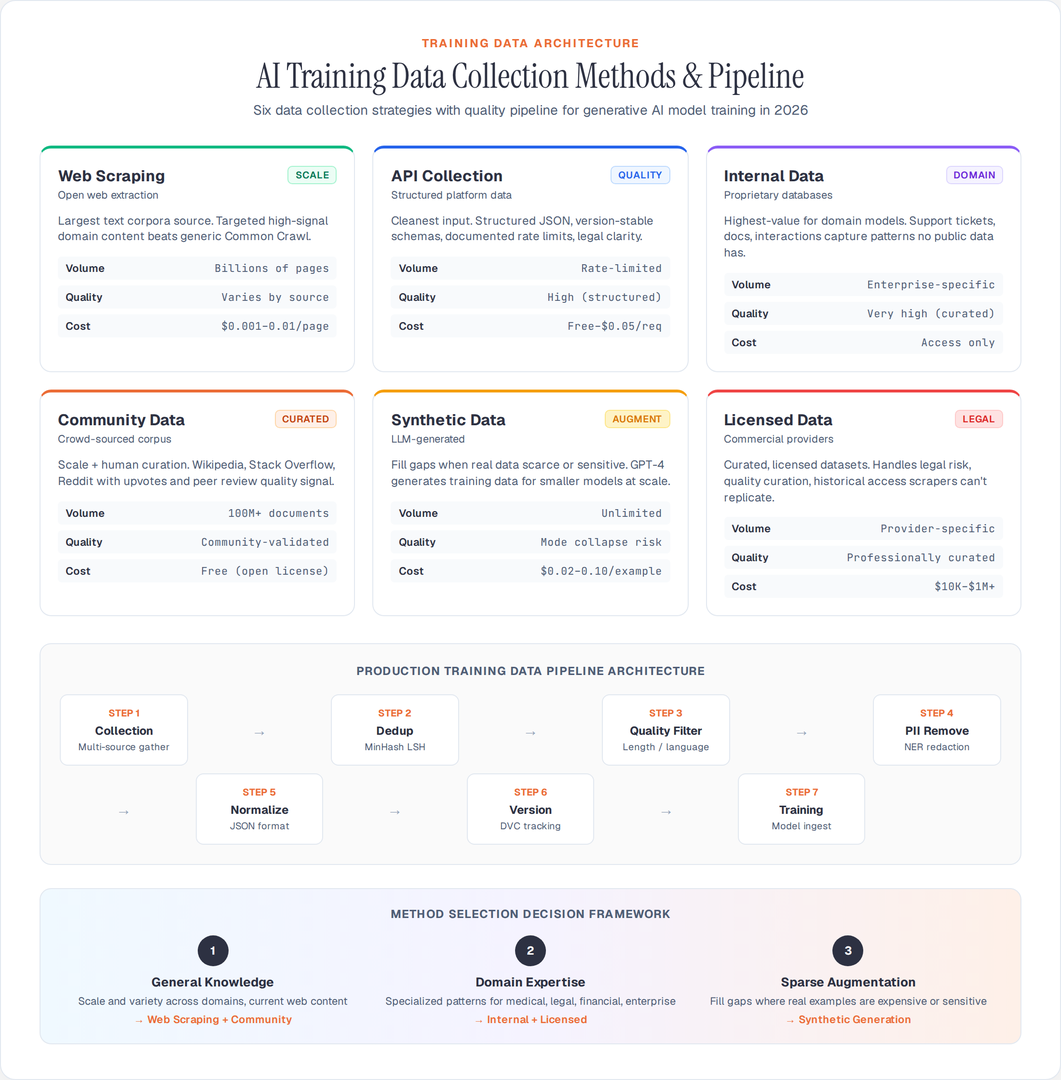
Data Pipeline Architecture
Production AI training data collection isn't a one-time extract. It's a continuous pipeline:
Collection layer (scraping, API, synthetic generation)
         ↓
Deduplication layer (MinHash LSH, exact hash)
         ↓
Quality filtering (length, language, perplexity score)
         ↓
PII removal (NER-based redaction)
         ↓
Format normalization (instruction-following JSON)
         ↓
Dataset versioning (tracked in DVC or similar)
         ↓
Training pipeline
Each stage should be reproducible and logged. Datasets that can't be traced back to their source are technical debt that surfaces as unexplained model behavior.
Practical Decision Framework
| Need | Method | Why |
|---|---|---|
| General domain knowledge | Web scraping + dedup | Scale and variety |
| Current events, recent data | API collection | Version-stable, timely |
| Domain-specific expertise | Internal databases | Highest signal |
| Structured Q&A pairs | Community datasets | Pre-validated quality |
| Augment sparse examples | Synthetic generation | Cost-effective at scale |
| Legal/medical/financial | Licensed third-party | Legal clarity + quality |
Most production pipelines combine three to four of these methods. Web text provides scale; internal data provides domain depth; synthetic data fills specific gaps; community data provides validated Q&A structure. The combination outperforms any single source.
Start with data quality, not data quantity. A well-curated 100K example dataset consistently outperforms a noisy 10M example one on downstream model performance.
Author

Author