Best 10 Cloud GPU Providers in 2026: Ranked by Value and Performance
Cover Image
The AI boom has made GPU compute the most contested resource in cloud infrastructure. In 2026, accessing powerful GPUs no longer requires buying expensive hardware upfront. Cloud GPU providers have responded with better pricing, wider GPU selection, and infrastructure specifically built for machine learning and AI workloads. Whether you're training foundation models, running inference at scale, or rendering complex 3D scenes, there's a GPU cloud platform that fits your needs and budget.
This guide ranks the top 10 cloud GPU providers available in 2026, based on GPU availability, pricing, ease of use, and real-world suitability for different workloads.
Why Cloud GPU Providers Are Essential in 2026
The demand for GPU compute has fundamentally changed how teams approach AI development. Training a competitive large language model or fine-tuning a vision model requires either a significant hardware investment or reliable cloud access. For most teams, cloud GPU is the only practical choice.
The economics are compelling. A single NVIDIA H100 costs thousands of dollars, plus the infrastructure to power, cool, and network it. Cloud GPU converts that capital expense into operational cost, with the added benefit of elastic scaling. You can spin up 100 GPUs for a three-day training run and shut them down when done, without owning anything that sits idle.
Accessibility has also improved dramatically. Frameworks like TensorFlow and PyTorch integrate with virtually every major provider, meaning you can move from local development to cloud-scale training without rewriting code. For solo practitioners and enterprise teams alike, cloud GPU providers have become essential infrastructure rather than a luxury.
What to Look for in a Cloud GPU Provider
Not all GPU cloud platforms are created equal. Here's what matters most when choosing a provider for your workload.
GPU availability and generation is the starting point. NVIDIA A100 and H100 GPUs dominate serious AI workloads. H200 and newer Blackwell-generation chips are beginning to appear in enterprise deployments. For inference and development, RTX 4090 cards offer exceptional value at 24GB VRAM.
Pricing structure varies widely. Hourly on-demand pricing is standard, but spot or preemptible instances can cut costs by 30-70%. Some providers charge for data egress, which adds up fast for large dataset transfers.
Integration and tooling matters for workflow speed. Managed MLOps platforms, pre-configured environments, and Docker support reduce the time from sign-up to running code.
Geographic coverage and data residency affect latency and compliance. European teams handling sensitive data may prefer GDPR-compliant providers. Teams in Asia may find local providers faster and more cost-effective.
Top 10 Cloud GPU Providers in 2026
1. Amazon Web Services (AWS)
AWS remains the largest cloud platform and the default choice for many enterprise teams. Its P4d instances pack 8x NVIDIA A100 40GB GPUs per node, while newer P5 instances offer H100-based configurations with dramatically improved training performance for large-scale AI workloads.
AWS's ecosystem is both its greatest strength and most common criticism. If your team already relies on S3, ECS, or SageMaker, adding GPU compute feels natural within the same dashboard and billing structure. SageMaker JumpStart provides pre-trained models and managed training pipelines that accelerate common ML workflows.
The tradeoff is cost and complexity. AWS GPU instances are not cheap, and the broader platform offers enough configuration options to overwhelm beginners. Organizations with dedicated cloud infrastructure teams get the most value here.
2. Google Cloud Platform (GCP)
Google Cloud has staked its reputation on AI infrastructure, and the results show in its GPU offerings. GCP provides access to NVIDIA A100 and H100 GPUs alongside its proprietary Tensor Processing Units (TPUs), which remain uniquely powerful for large-scale matrix operations common in transformer-based models.
The TPU advantage is real for teams running standard transformer architectures. TPU pods scale to thousands of chips with a communication fabric that GPUs can't easily match for the largest training runs. GCP's integration with Vertex AI provides an end-to-end MLOps platform that handles everything from experiment tracking to model deployment.
GCP's global network is competitive with AWS, and for teams prioritizing AI and ML capabilities, it often offers better value per dollar. The learning curve for teams new to GCP is gentler than AWS for ML-specific workloads.
3. Microsoft Azure
Azure appeals most to organizations already embedded in the Microsoft ecosystem. Its N-series virtual machines offer GPU options ranging from NVIDIA K80 to H100, and Azure Machine Learning provides a mature managed platform for the full ML lifecycle.
The standout advantage is enterprise integration. If your team uses Windows Server, Active Directory, SQL Azure, or other Microsoft products, adding GPU compute to the same management plane simplifies operations. Azure's compliance certifications cover the broadest range of regulated industries, which matters for healthcare, finance, and government deployments.
For AI-specific workloads, Azure's offerings have matured significantly, though some specialized MLOps features still lag behind GCP's ecosystem. Hybrid cloud capabilities through Azure Arc give it an edge for organizations that need to bridge on-premise and cloud GPU infrastructure.
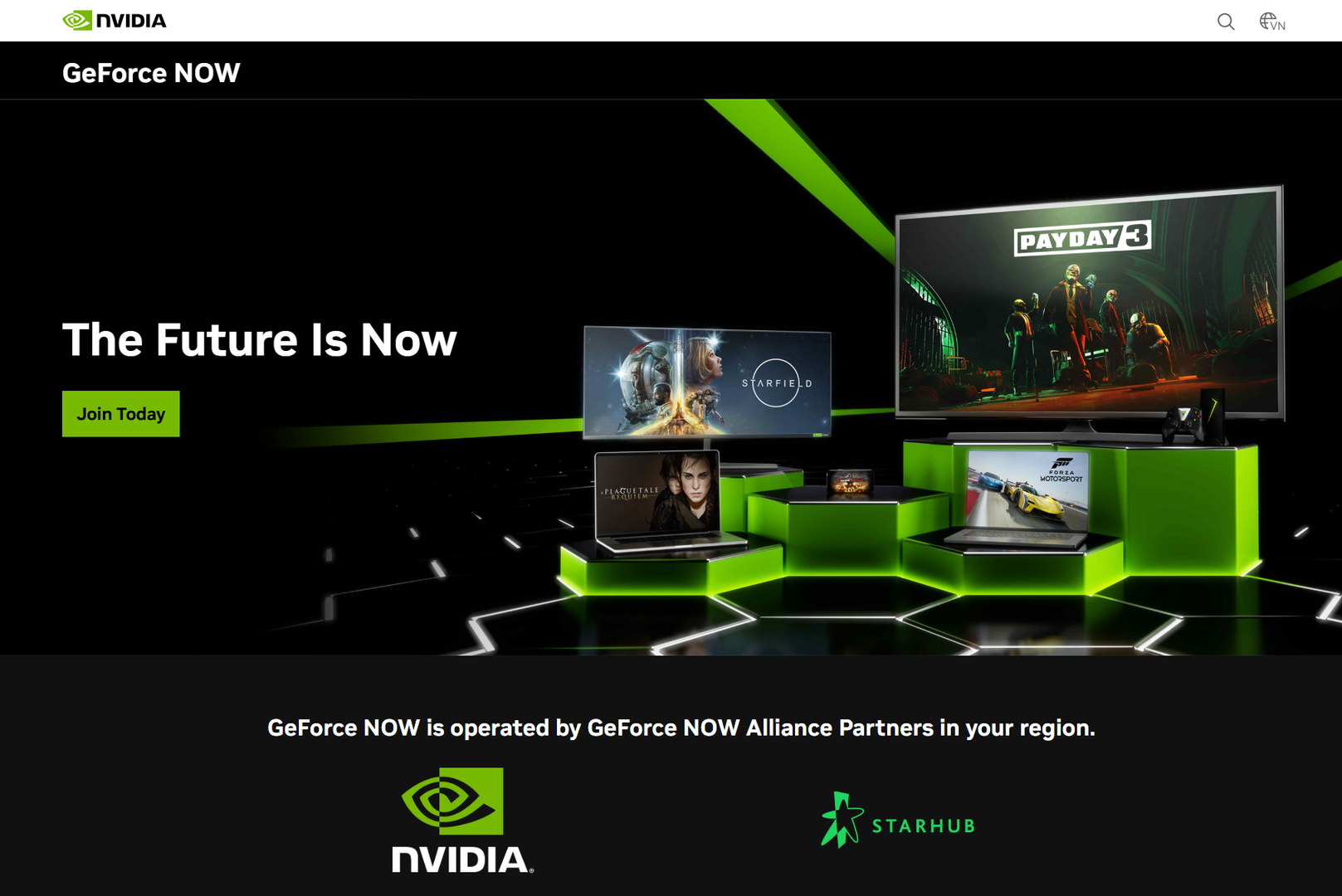
4. NVIDIA GeForce NOW
NVIDIA GeForce NOW occupies a specific niche that the other providers on this list don't address: cloud gaming and interactive graphics rendering. Rather than offering general GPU compute, it streams PC games from NVIDIA's data centers to virtually any device.
This matters for developers working on game assets, VR content, or graphics-intensive applications who don't want to invest in high-end gaming hardware. The platform has expanded its game library and improved streaming quality substantially since its earlier versions.
It's not a replacement for GPU compute infrastructure. GeForce NOW doesn't give you a terminal, root access, or the ability to install custom frameworks. But for its intended audience of gamers and creative professionals, it remains the clearest option in the market.
5. Vast.ai
Vast.ai has become the go-to choice for cost-conscious ML practitioners who don't need enterprise SLAs. It operates as a marketplace connecting GPU buyers with hosters who have idle compute capacity, creating competitive pricing that undercuts major cloud providers significantly.
RTX 4090 instances on Vast.ai typically run $0.50-$0.90 per hour, roughly half what comparable AWS configurations cost. A100 instances are available at $2.00-$3.50 per hour for 40GB variants. The tradeoff is that reliability varies by host, and you won't get a service level agreement.
For researchers, independent developers, and small teams running development workloads, Vast.ai's price-to-performance ratio is hard to beat. The platform has improved its interface and documentation substantially, making it accessible to users who aren't infrastructure experts. If you need guaranteed uptime for production workloads, look elsewhere.
6. RunPod
RunPod bridges the gap between bare marketplace pricing and fully managed enterprise infrastructure. It offers both serverless GPU functions and dedicated persistent endpoints, giving teams flexibility in how they consume GPU compute.
The serverless offering is particularly well-designed for inference workloads. You pay per second for GPU time consumed, without needing to manage persistent instances. Persistent endpoints provide the stability of a dedicated VM with the convenience of container-based deployment. RunPod's custom tooling for common ML frameworks reduces the setup friction that plagues other platforms.
Pricing for RTX 4090 instances starts around $0.69 per hour, with dedicated A100 80GB configurations reaching $3.99-$5.49 per hour. The managed overhead costs slightly more than Vast.ai equivalents, but the reliability and support justify the premium for teams who need more than a marketplace can guarantee.
7. Hetzner
Hetzner has expanded from its web hosting roots into GPU instances, and for European teams, it offers something the American hyperscalers can't easily match: GDPR-compliant bare-metal GPU servers at competitive prices.
The AX101 dedicated server features an NVIDIA RTX 4090 at prices significantly lower than comparable cloud instances, and as a bare-metal provider, there's no virtualization overhead. Hetzner's German and Finnish data centers serve European users with low latency and full data sovereignty compliance.
The limitation is variety. Hetzner's GPU options are narrower than the major clouds, and inventory can be scarce during high-demand periods. For teams that prioritize cost, EU data residency, and reliable bare-metal performance over a wide GPU selection, Hetzner is an excellent choice.
8. CoreWeave
CoreWeave built its reputation specifically as an AI-focused cloud provider, differentiating from general-purpose clouds through deep NVIDIA partnerships and infrastructure optimized for machine learning workloads.
The company gained significant attention for its early adoption of H100 clusters and its液冷 data center design, which allows sustained high-performance GPU operation. CoreWeave's Kubernetes-native approach integrates cleanly with modern ML tooling, and its custom networking reduces communication bottlenecks in distributed training.
As the AI cloud market has matured, CoreWeave's pricing has become less aggressively competitive, but it remains a top choice for teams running serious training workloads who want managed infrastructure without the complexity of AWS or GCP. The platform's specialization in AI means less distraction from unrelated cloud services.
9. Oracle Cloud Infrastructure (OCI)
Oracle Cloud Infrastructure often flies under the radar compared to the three major hyperscalers, but for specific use cases, it offers compelling advantages. Oracle's GPU instances provide competitive pricing for compute-intensive workloads, and bare-metal configurations offer low-latency performance that appeals to HPC and enterprise applications.
The strongest case for OCI is organizations already using Oracle Database or Oracle Cloud Applications. Tight integration between GPU compute and Oracle's database services simplifies architectures that need both streaming data processing and model inference. Oracle's licensing arrangements for commercial software also work more cleanly within OCI than on competing clouds.
OCI's AI and ML ecosystem is less developed than AWS, GCP, or Azure, which matters less for teams bringing their own frameworks but more for those relying on managed AI services. The infrastructure is solid; the tooling is catching up.
10. Alibaba Cloud
Alibaba Cloud dominates GPU cloud infrastructure in the Asia-Pacific region and has expanded globally with competitive offerings. For teams deploying applications in Asia or serving Asian markets, it often provides better regional coverage and pricing than the American hyperscalers.
Alibaba Cloud's EGS and ECS GPU instances offer NVIDIA configurations similar to Western providers, with pricing that reflects its lower regional operating costs. The platform has invested heavily in AI-specific infrastructure, including its own development frameworks and model deployment tools.
The language barrier and customer support maturity outside China remain practical considerations. Documentation and support quality in English can lag behind the American providers. For teams specifically targeting Asia-Pacific markets or looking for cost-effective GPU compute without US-centric data residency, Alibaba Cloud is worth serious consideration.
How to Choose the Right Cloud GPU Provider
The best provider depends on your specific context. Here is a quick decision framework:
Choose AWS, GCP, or Azure if you need enterprise-grade SLAs, broad geographic coverage, and a complete cloud ecosystem. The major hyperscalers offer the most mature infrastructure and compliance certifications, at premium pricing.
Choose Vast.ai or RunPod if cost efficiency and ML-focused tooling matter more than enterprise SLAs. Both platforms have narrowed the usability gap with the big clouds significantly.
Choose Hetzner if GDPR compliance, European data residency, or bare-metal value pricing are priorities. Its GPU selection is narrower, but the price-to-performance for European workloads is excellent.
Choose CoreWeave if you're running large-scale AI training and want specialized infrastructure without the complexity of configuring general-purpose clouds.
Choose OCI or Alibaba Cloud if you have specific regional requirements, existing relationships with those ecosystems, or unique licensing considerations.
The Bottom Line
The cloud GPU landscape in 2026 is far more mature and competitive than it was even two years ago. The key changes from 2025 include much broader H100 availability across providers, significantly improved RTX 4090 pricing from marketplace platforms, and the consolidation of specialized providers like Paperspace and Lambda Labs out of the market.
For most ML practitioners in 2026, the decision comes down to workload type and budget. Development and research work is well-served by Vast.ai or RunPod. Production AI workloads at scale lean toward CoreWeave, GCP, or AWS. Whatever you choose, the cloud GPU market is healthy enough that you can find reliable infrastructure for virtually any budget.
If you found this guide useful, explore our coverage of the best Python data science courses to build the skills needed to make the most of cloud GPU infrastructure, or dive into our comparison of web scraping with Python versus Node.js for another practical angle on modern development tools.