Best Python Data Science Courses in 2026: From Fundamentals to Production ML
The Python data science ecosystem in 2026 is radically different from even three years ago. Traditional Jupyter-notebook-only workflows have evolved into full-stack ML engineering pipelines. Polars is challenging Pandas for DataFrames. LLM-augmented analysis is standard in enterprise tooling. And the gap between "data science student" and "ML engineer who ships" keeps widening.
Choosing the right course determines whether you build real skills or collect certificates that gather dust. This guide evaluates the best Python data science courses available in 2026, scored on curriculum relevance, tool coverage, project depth, and career outcome data.
1. Structured Learning Platforms: Certificate Programs
IBM Data Science Professional Certificate (Coursera)
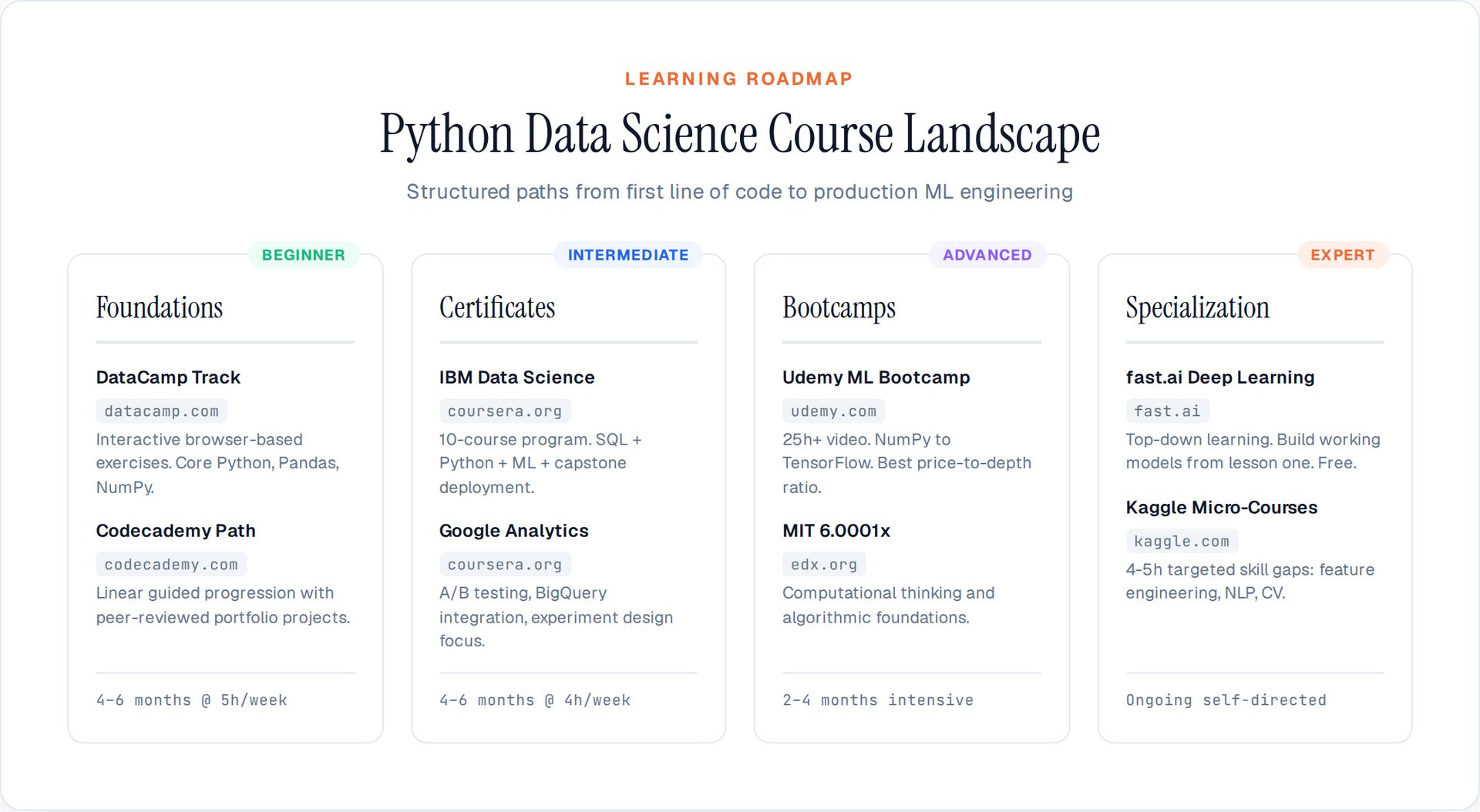
IBM's 10-course certificate program on Coursera remains one of the most comprehensive entry points. In 2026, IBM has updated the curriculum to include:
- Python 3.12+ features (pattern matching, ExceptionGroups)
- SQL + Python integration workflows
- Hands-on labs using IBM Watson Studio and Jupyter
- Capstone project requiring end-to-end pipeline: data collection, cleaning, EDA, ML model, deployment
The certificate carries weight with enterprise employers. Expect 4–6 months at 4 hours per week.
Google Advanced Data Analytics Certificate (Coursera)
Google's newer certificate (launched late 2023, updated for 2026) focuses on the analytics engineering side. Its curriculum covers:
- Python + BigQuery integration
- Statistical analysis with SciPy and statsmodels
- Regression, classification, and clustering with scikit-learn
- Tableau visualization alongside Python plotting
The key differentiator is Google's emphasis on A/B testing and experiment design—skills rarely covered in traditional data science courses.
2. Interactive Coding Platforms
DataCamp — Data Scientist with Python Track
DataCamp's browser-based coding environment excels at building muscle memory. The "Data Scientist with Python" track includes 25+ courses covering:
- Core Python, Pandas, and NumPy
- Statistical thinking and hypothesis testing
- Supervised and unsupervised learning with scikit-learn
- Deep learning fundamentals with Keras
DataCamp's strength is repetition-based learning. Each lesson pairs a short video with immediate hands-on coding exercises. The platform now integrates AI-powered code review that catches common anti-patterns in student submissions.
Codecademy — Data Science Career Path
Codecademy's career path offers a more guided, linear progression than DataCamp's modular approach. Updated for 2026, it includes:
- Python fundamentals through web scraping projects
- SQL for data retrieval and joins
- Statistical inference and probability
- Portfolio projects with peer review
3. University-Level Depth: edX and Specializations
MIT Introduction to Computer Science and Programming Using Python (edX)
MIT's 6.0001x remains the gold standard for building computational thinking alongside Python mastery. It teaches:
- Algorithmic complexity and Big-O analysis
- Recursive problem solving
- Object-oriented design patterns
- Basic optimization and simulation
This course is not "data science" in the applied sense—it builds the computer science foundation that separates strong data scientists from those who can only call library functions.
Harvard CS50's Introduction to AI with Python (edX)
For those specifically interested in the AI side of data science, Harvard's CS50 AI course covers:
- Search algorithms and knowledge representation
- Probability and Bayesian networks
- Machine learning theory (not just API calls)
- Natural language processing and computer vision fundamentals
4. Bootcamp-Style Intensive Programs
Udemy — Python for Data Science and Machine Learning Bootcamp
Jose Portilla's Udemy bootcamp remains one of the highest-rated paid courses globally. The 2026-updated curriculum includes:
- Complete NumPy, Pandas, and Matplotlib workflows
- Seaborn and Plotly for modern visualization
- Scikit-learn for supervised and unsupervised learning
- Natural Language Processing with NLTK
- Deep learning with TensorFlow 2.x
At under $20 during Udemy sales, the price-to-content ratio is unmatched. The course includes lifetime access and over 25 hours of video content.
365 Data Science — Complete Data Science Bootcamp
This structured bootcamp covers:
- Mathematics for data science (linear algebra, calculus, statistics)
- Python programming from zero
- Machine learning theory and implementation
- Real-world case studies from finance and marketing
5. Specialized and Advanced Tracks
fast.ai — Practical Deep Learning for Coders
For programmers ready to move beyond classical ML, fast.ai's free course teaches deep learning top-down. Instead of starting with theory, you build working models in the first lesson:
- Image classification, NLP, and tabular data
- Transfer learning and fine-tuning
- The fastai library built on PyTorch
- Deployment to production environments
Jeremy Howard's teaching philosophy—start with results, then peel back the layers—has produced some of the most capable self-taught ML practitioners in the industry.
Kaggle Learn — Micro-Courses
Kaggle's free micro-courses are perfect for filling specific skill gaps:
- Intro to Machine Learning (4 hours)
- Intermediate Machine Learning (4 hours)
- Feature Engineering (5 hours)
- Intro to Deep Learning (4 hours)
Each course runs directly in Kaggle notebooks and includes competition-style exercises. No setup required.
6. Choosing the Right Path for Your Career Stage
Complete Beginners (No Python Experience):
Start with Codecademy's career path or DataCamp's track. Both provide the guided structure and immediate feedback needed when every concept is new.
Developers Adding Data Science Skills:
Skip beginner Python courses. Go directly to the Udemy bootcamp or Google's Advanced Analytics certificate. Your programming foundation means you can absorb data science concepts faster through project-based learning.
Career Changers Targeting Job Offers:
Combine the IBM or Google certificate (for resume credibility) with Kaggle competitions (for demonstrable skill). Employers in 2026 weigh portfolio projects alongside certificates.
Working Data Scientists Going Deeper:
fast.ai for deep learning, MIT 6.0001x for computational foundations, or specialized Coursera specializations in NLP or computer vision.
The best course is the one you finish—and then apply. Pick a learning path, commit to a daily practice schedule, and build projects that solve problems you personally care about. That combination of structured learning and authentic application is what turns course completers into working data scientists.
Author

Author