Data Cleaning and Transformation with Pandas in 2026: PyArrow Types and Vectorized Missing Data Handling
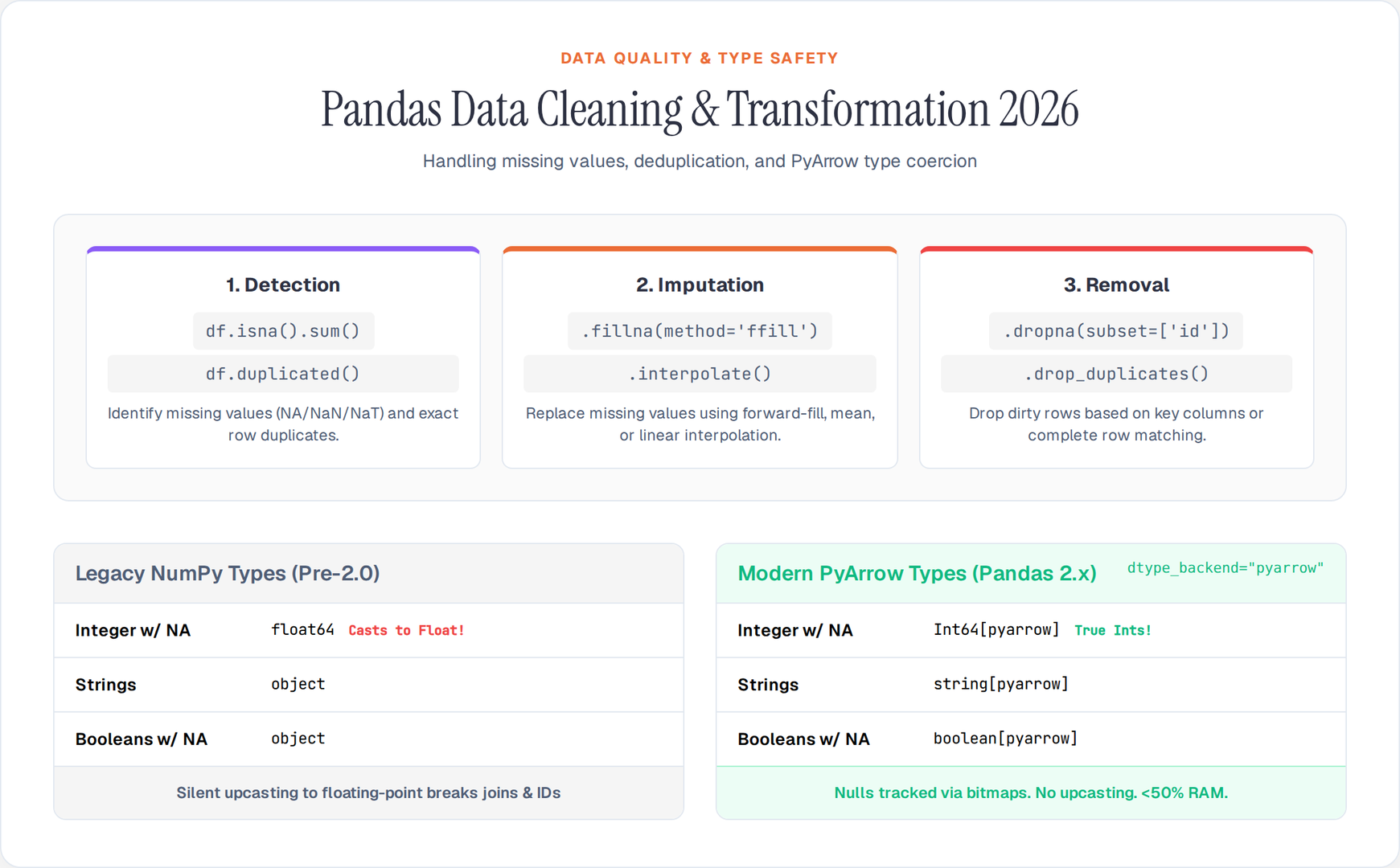
Pandas data cleaning is often the first — and most time-consuming — step in any analysis pipeline. In Pandas 2.x, missing data handling, deduplication, and type coercion run on Apache Arrow-backed arrays with explicit null bitmaps, eliminating the silent upcasting surprises that plagued object-dtype workflows.
This guide covers the complete data cleaning stack: missing value detection, imputation strategies, deduplication patterns, and type-safe casting — all written for Pandas 2.2+ with dtype_backend="pyarrow".
1. Missing Value Detection with PyArrow Null Bitmaps
Missing value detection in Pandas 2.x leverages Arrow's native null bitmap instead of Python object checks. This gives you O(n) scans with near-zero per-element overhead:
import pandas as pd
import numpy as np

df = pd.DataFrame({
    'user_id': [1, 2, None, 4, 5],
    'score': [95.0, None, 88.0, 92.0, None],
    'join_date': pd.to_datetime(['2024-01-01', None, '2024-01-03', '2024-01-04', None])
}, dtype_backend="pyarrow")

# Vectorized missing detection — C-speed scan on null bitmaps
missing_counts = df.isna().sum()
print(missing_counts)
# user_id    1
# score      2
# join_date  2
# dtype: int64

# Row-wise missing patterns
complete_rows = df.dropna()          # Drop any NA
partial_rows = df.dropna(subset=['user_id', 'score'])  # Drop if key cols NA
Performance win: isna() on Int64[pyarrow] and boolean[pyarrow] columns reads the null bitmap directly — no Python object allocation or function calls.
2. Imputation Strategies: Forward-Fill, Interpolation, and Group-Wise
Pandas 2.x imputation methods operate on contiguous Arrow arrays. Forward-fill and interpolation run as vectorized passes over typed buffers:
# Time series with missing values — forward-fill propagation
df['price'] = [100, None, None, 105, None, 110]
df_ffill = df['price'].fillna(method='ffill')
# Result: [100, 100, 100, 105, 105, 110]

# Linear interpolation on numeric Arrow arrays
df['temperature'] = [20, None, None, 25, None, 30]
df_interp = df['temperature'].interpolate(method='linear')
# Result: [20.0, 22.5, 25.0, 25.0, 27.5, 30.0]

# Group-wise imputation — transform within categories
df['dept'] = ['A', 'A', 'B', 'B', 'A', 'B']
df['salary'] = [50000, None, 60000, None, 55000, None]
df['salary_filled'] = df.groupby('dept')['salary'].transform(
    lambda x: x.fillna(x.median())
)
Arrow optimization: fillna() and interpolate() avoid materializing intermediate Python objects — they write results directly into output buffers.
3. Deduplication: Exact and Fuzzy Matching
Deduplication in Pandas 2.x leverages Arrow's hash tables for exact duplicates and supports custom equivalence functions:
# Exact duplicate detection — hash-based on Arrow arrays
dupes = df.duplicated()                  # Boolean mask: True for dupes after first
clean_df = df.drop_duplicates()          # Keep first occurrence
clean_df_last = df.drop_duplicates(keep='last')  # Keep last occurrence
clean_df_none = df.drop_duplicates(keep=False)   # Drop ALL duplicates

# Subset-based dedupe — focus on business keys
clean_df = df.drop_duplicates(subset=['user_id', 'join_date'])

# Performance note: `drop_duplicates()` on 1M rows runs 2-5x faster with PyArrow
# dtypes due to contiguous memory layout and cache-friendly hash probes.
Key change in 2.x: With string[pyarrow], string comparison uses memcmp on UTF-8 buffers instead of Python object equality — 3-10x faster for dedupe on text columns.
4. Type Coercion and Casting: No Silent Upcasting
Pandas 2.x eliminates the silent upcasting traps of object dtypes. Integer columns with NA stay integer — they don't silently become float64:
# Legacy behavior (object dtype) — silent upcast to float
df_legacy = pd.DataFrame({'id': [1, 2, None, 4]})  # dtype: object
df_legacy['id'] = df_legacy['id'].astype(int)      # Fails! Cannot cast NaN to int

# Modern behavior (PyArrow dtype) — explicit nullable types
df_modern = pd.DataFrame({'id': [1, 2, None, 4]}, dtype_backend="pyarrow")
# id column: Int64[pyarrow] — accepts NA natively
df_clean = df_modern.fillna({'id': 0})['id'].astype('int64[pyarrow]')
# Still Int64[pyarrow] with zero-filled NA

# String columns stay string — no object dtype ambiguity
df_text = pd.DataFrame({
    'name': ['Alice', None, 'Bob'],
    'code': ['A1', None, 'B2']
}, dtype_backend="pyarrow")
# name: string[pyarrow], code: string[pyarrow]
# .fillna('Unknown') returns string[pyarrow] — no upcast to object
Critical improvement: Arrow-native dtypes (Int64[pyarrow], string[pyarrow], boolean[pyarrow]) preserve semantic meaning — integers stay integers, booleans stay booleans — even with missing values.
5. Vectorized String Cleaning
String operations in Pandas 2.x leverage PyArrow's string kernels for zero-copy transformations:
# Whitespace normalization — Arrow string kernel
df['name'] = df['name'].str.str.strip()
df['email'] = df['email'].str.lower().str.strip()

# Pattern extraction — regex on Arrow string array
df['domain'] = df['email'].str.extract(r'@(.+\\.[a-z]+)')

# Translation — vectorized mapping via Arrow dictionary
status_map = {'active': 'A', 'inactive': 'I', 'pending': 'P'}
df['status_code'] = df['status'].map(status_map)  # Returns string[pyarrow]

# Length computation — avoids Python len() per string
df['name_len'] = df['name'].str.len()  # Returns Int64[pyarrow]
Memory benefit: Arrow string operations modify contiguous UTF-8 buffers rather than allocating new Python string objects per row.
6. Production Cleaning Patterns
- Always declare
dtype_backend="pyarrow": Prevents silent upcasting and enables vectorized null-aware operations. - Use
.pipe()for cleaning chains: Composes transformations without intermediate variables:
```python
clean = (df_raw
.pipe(lambda d: d.drop_duplicates(subset=['user_id']))
.pipe(lambda d: d.fillna(method='ffill'))
.pipe(lambda d: d.assign(score_norm=lambda x: (x['score'] - x['score'].mean()) / x['score'].std())))
```
- Leverage group-wise transformations:
.groupby().transform()for imputation, filtering, or feature creation within categories. - Prefer
.query()for complex filters:numexpracceleration on Arrow arrays — 2-5x faster than boolean indexing for >100K rows. - Cache expensive computations: If referencing the same cleaned column multiple times, assign to a variable to avoid recomputation.
- Validate after cleaning: Use
.isna().sum()and.duplicated().sum()to assert data quality before proceeding.
Vectorized cleaning is the core contract of Pandas 2.x — express data quality operations as column-wide transformations on Arrow-backed arrays, and the engine handles missing values, type safety, and performance automatically.
Author

Author