Amazing Data Analytics Blogs Every Beginner and Expert Should Follow in 2026
Cover Image

The landscape of data analytics content has shifted dramatically by 2026. The days of generic "How to use Pandas" tutorials dominating your feed are largely over, replaced by AI code-assistants handling the boilerplate. Today, the most valuable data analytics blogs focus on system architecture, analytics engineering, causal inference, and LLM evaluations.
Also, the platform has changed: independent Substacks and specialized engineering roundups have largely overtaken traditional open platforms like Medium for high-signal content.
Whether you are just starting your data journey or are a lead architect designing an enterprise data platform, here are the essential data analytics blogs you should be reading in 2026.
1. Best Blogs for Beginners and Generalists
When you are first starting out, you need structured, reliable content that explains both the technical implementation and the business context of data.
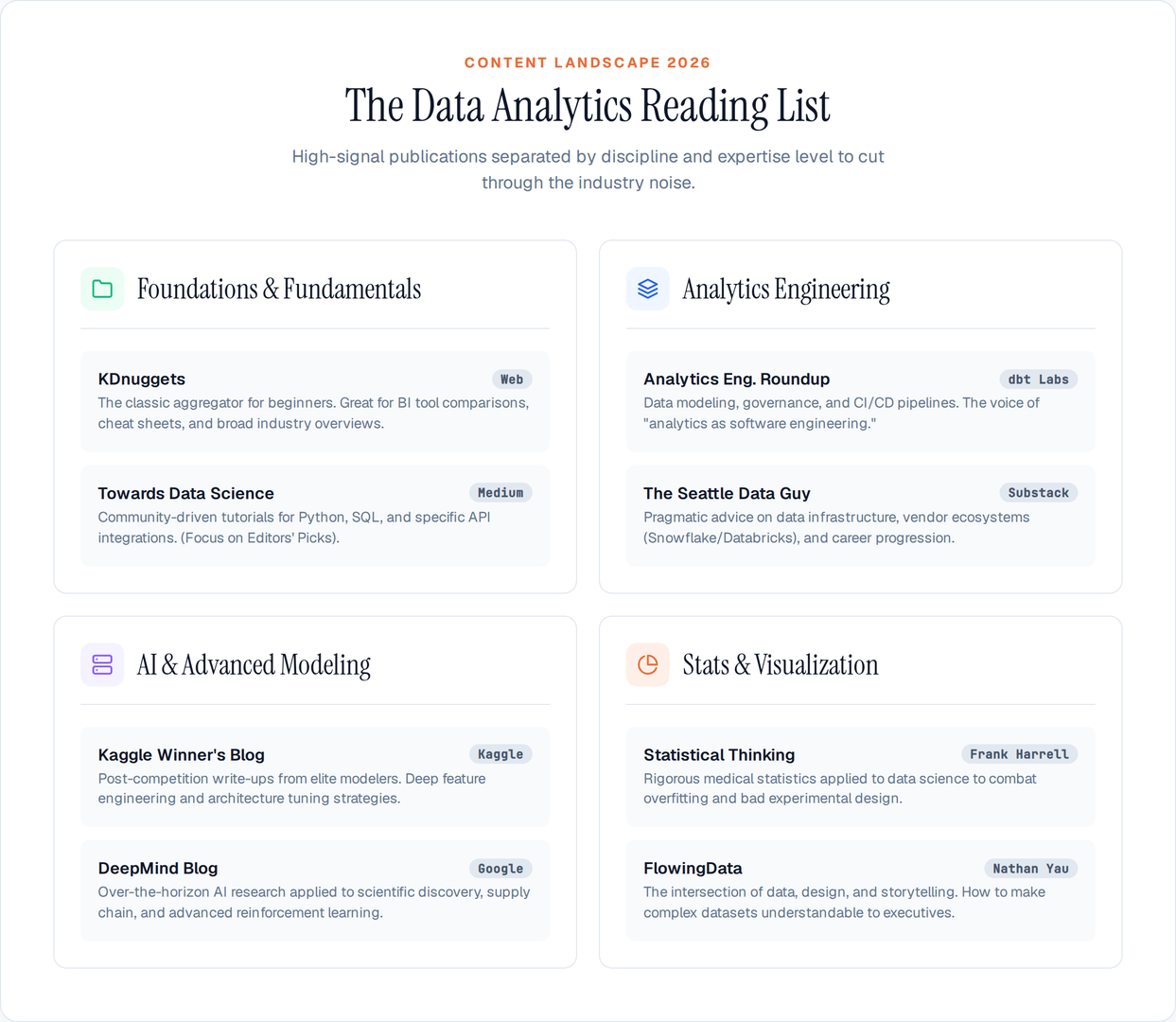
KDnuggets
Despite the shift in the media landscape, KDnuggets remains a cornerstone for beginners. In 2026, their focus has evolved to cover the intersection of traditional data analytics and prompt engineering. If you need a high-level overview of a new framework, a comparison of BI tools, or a cheat sheet for Polars, KDnuggets is still one of the most reliable aggregators on the web.
Towards Data Science
TDS remains a massive repository of community-driven knowledge. While it requires some filtering to find the highest-quality posts among the noise, its "Editors' Picks" section consistently surfaces excellent, beginner-friendly tutorials. It is particularly good for step-by-step walkthroughs of specific libraries, API integrations, and visualization techniques.
2. Best Blogs for the Modern Analytics Engineer
The line between Data Analyst and Data Engineer has effectively disappeared. Modern analytics requires understanding cloud warehouses, version control, and CI/CD pipelines.
The Analytics Engineering Roundup (by dbt Labs)
If you want to understand how modern data teams actually operate, this newsletter is mandatory reading. It doesn't focus on Python syntax; instead, it focuses on data modeling, governance, pipeline testing, and how to structure analytics teams for success. It is the defining publication of the "Analytics as Software Engineering" movement.
The Seattle Data Guy (Substack)
Run by Ben Rogojan, this blog bridges the gap between data engineering and data analytics. It provides incredibly pragmatic advice on data infrastructure, data vendor ecosystems (like Snowflake vs. Databricks), and career progression. If you want to know what tools companies are actually buying and implementing in 2026, this is where you look.
3. Must-Reads on AI and Advanced Machine Learning
Data analytics can no longer be separated from AI. Understanding how to analyze unstructured data via LLMs is now a core competency.
The Kaggle Winner's Blog
Kaggle's blog remains the best place to learn how to squeeze every drop of performance out of a model. The post-competition write-ups from top Kagglers reveal practical, battle-tested techniques for feature engineering and model tuning that you simply won't find in academic papers.
Google DeepMind Blog
For those looking over the horizon, the DeepMind blog is essential. While highly technical, their posts on deploying AI for scientific discovery, supply chain optimization, and reinforcement learning provide a look at what the enterprise data analytics teams will be building three years from now.
4. Specialized: Statistics and Data Visualization
Tools change, but the fundamentals of human perception and mathematical probability do not.
Statistical Thinking (by Frank Harrell)
In an era where people blindly throw machine learning algorithms at every dataset, Dr. Frank Harrell's blog is a necessary grounding in rigorous statistics. He writes extensively on the dangers of poor experimental design, the misuse of p-values, and how to build models that actually reflect reality rather than just overfitting to noise.
FlowingData (by Nathan Yau)
Data visualization has moved past basic bar charts. Nathan Yau’s blog explores the intersection of data, design, and storytelling. FlowingData is less about the code (though tutorials are provided) and more about the why—how to choose the exact right visual metaphor to make a complex dataset instantly understandable to a non-technical executive.
How to Consume Data Content Effectively
The biggest mistake junior analysts make is consuming too much content without writing any code. In 2026, the signal-to-noise ratio is lower than ever due to AI-generated spam.
Pick two or three high-quality newsletters, subscribe to them, and when you read a tutorial that solves a problem you care about, open your terminal and build it yourself. Reading about data architecture is entertainment; building it is experience.
Author

Author