Web Scraping for Lead Generation: A Practical 2026 Guide
Introduction
Lead generation through web scraping has evolved dramatically by 2026. What started as basic contact extraction has transformed into sophisticated, AI-powered systems that identify high-intent prospects across multiple touchpoints while maintaining strict compliance with data protection regulations.
This guide covers modern lead generation scraping: from ethical frameworks and legal compliance to production-scale architectures that process millions of prospects monthly.
What is Lead Generation Web Scraping?
Lead generation scraping automates the discovery and extraction of potential customer information from publicly available web sources. Unlike traditional contact scraping, modern lead generation focuses on behavioral signals, intent data, and qualification criteria.
Key components:
- Prospect identification: Finding businesses or individuals who match your ideal customer profile
- Intent signal detection: Identifying prospects actively researching solutions in your space
- Contact enrichment: Gathering comprehensive contact information and company data
- Lead scoring: Automated qualification based on extracted attributes
Legal Framework and Compliance (2026 Standards)
GDPR and Data Protection Requirements
The European Union's GDPR continues to set the global standard for data protection. Key requirements for lead generation scraping:
Lawful basis for processing:
- Legitimate interest (most common for B2B lead generation)
- Consent (required for direct marketing to individuals)
- Contract performance (for existing customer expansion)
Data subject rights:
- Right to be informed about data collection
- Right of access to collected data
- Right to rectification of incorrect data
- Right to erasure ("right to be forgotten")
- Right to data portability
CCPA and Regional Variations
California Consumer Privacy Act (CCPA) and similar regional laws require:
- Clear privacy notices for data collection
- Opt-out mechanisms for data sales
- Data minimization practices
- Breach notification procedures
Practical compliance checklist:
- Collect only necessary data for legitimate business purposes
- Implement data retention and deletion policies
- Provide clear privacy notices and opt-out mechanisms
- Maintain records of processing activities
- Conduct data protection impact assessments
- Establish procedures for handling data subject requests
robots.txt and Website Terms of Service
robots.txt compliance:
- Always check and respect robots.txt directives
- Implement crawler delays as specified
- Avoid disallowed paths and directories
Terms of Service considerations:
- Review ToS before scraping any website
- Look for explicit scraping prohibitions
- Consider fair use and commercial restrictions
- Implement rate limiting to avoid service disruption
Technical Architecture for Scale
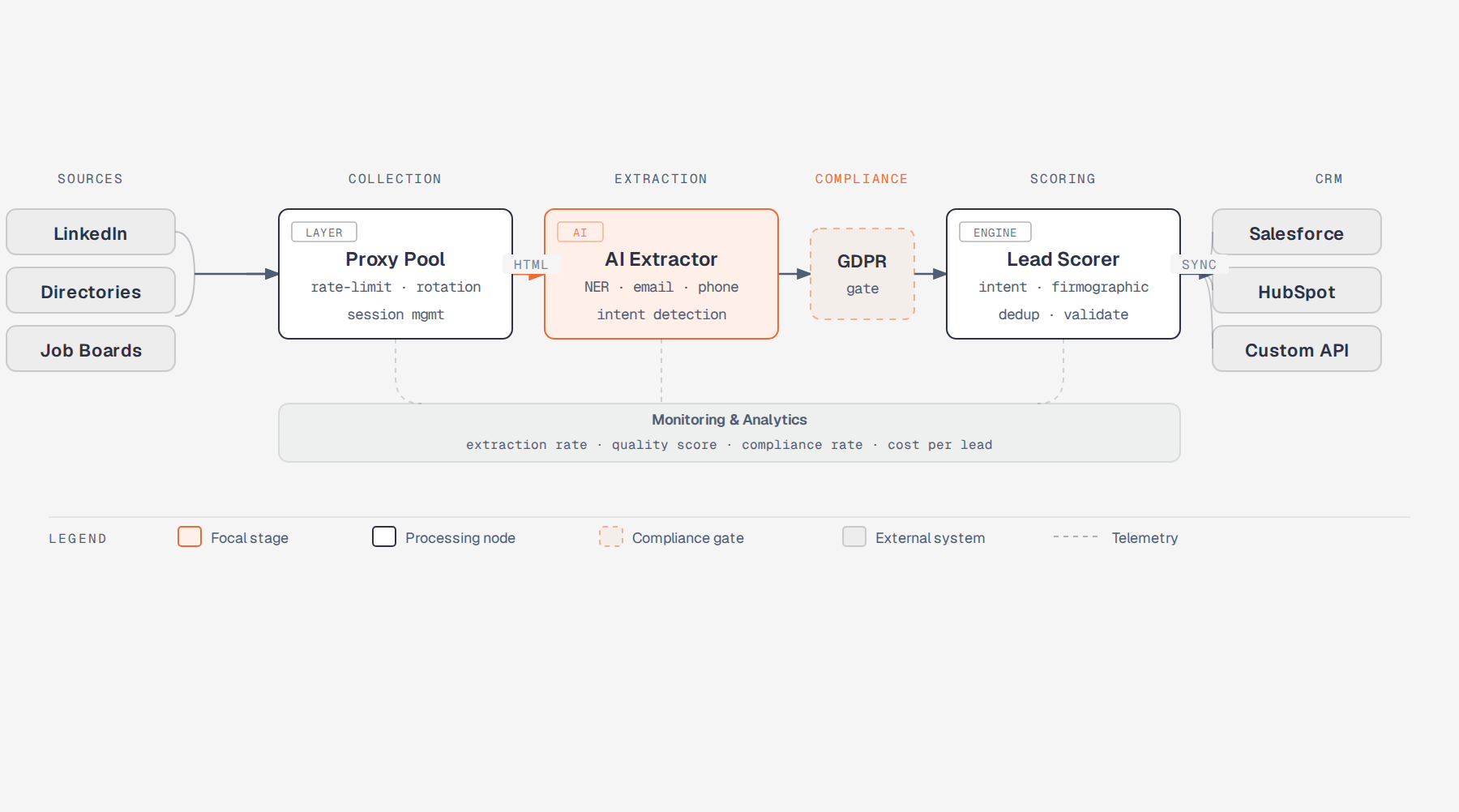
Modern Lead Generation Pipeline
Data Sources → Collection Layer → Processing Engine → Qualification → CRM Integration
     ↓              ↓                  ↓              ↓           ↓
  - LinkedIn     - Proxy Pool      - AI Extraction  - Scoring   - Salesforce
  - Company      - Rate Limiting   - Data Cleaning  - Routing   - HubSpot
    Websites     - Session Mgmt    - Enrichment    - Deduping   - Pipedrive
  - Job Boards   - CAPTCHA         - Validation    - Filtering  - Custom API
  - Directories    Solving         - Normalization
Infrastructure Components
Proxy and Session Management:
- Residential proxy pools with geographic distribution
- Session persistence for complex authentication flows
- Automatic IP rotation based on rate limiting signals
- CAPTCHA detection and solving integration
Data Processing Pipeline:
- Real-time data validation and cleansing
- AI-powered contact extraction from unstructured content
- Intent signal detection using natural language processing
- Automated lead scoring based on firmographic and behavioral data
Storage and Integration:
- Time-series databases for tracking engagement over time
- CRM integration with bi-directional data sync
- Data lakes for long-term analytics and model training
- Compliance audit logs for regulatory requirements
Python Implementation Framework
Core Dependencies and Setup
import asyncio
import aiohttp
from dataclasses import dataclass
from typing import List, Dict, Optional
import pandas as pd
from bs4 import BeautifulSoup
import requests
from selenium import webdriver
from selenium.webdriver.chrome.options import Options
import time
import json
import logging
from urllib.parse import urljoin, urlparse
from fake_useragent import UserAgent
Lead Data Model
@dataclass
class LeadProfile:
company_name: str
contact_name: Optional[str]
email: Optional[str]
phone: Optional[str]
job_title: Optional[str]
company_size: Optional[str]
industry: Optional[str]
website: str
linkedin_profile: Optional[str]
intent_score: int
source_url: str
extracted_date: str
compliance_status: str
Ethical Scraping Framework
class EthicalScraper:
    def __init__(self, base_delay=1.0, max_concurrent=5):
        self.base_delay = base_delay
        self.max_concurrent = max_concurrent
        self.session = aiohttp.ClientSession()
        self.user_agent = UserAgent()

    async def respect_robots_txt(self, domain: str) -> bool:
        """Check robots.txt compliance before scraping"""
        try:
            robots_url = f"https://{domain}/robots.txt"
            async with self.session.get(robots_url) as response:
                if response.status == 200:
                    robots_content = await response.text()
                    # Parse robots.txt and check User-agent: * rules
                    return self._parse_robots_rules(robots_content)
                return True
        except Exception as e:
            logging.warning(f"Could not fetch robots.txt for {domain}: {e}")
            return False

    def _parse_robots_rules(self, content: str) -> bool:
        """Parse robots.txt content for scraping permissions"""
        # Implementation would check Disallow rules, Crawl-delay, etc.
        lines = content.strip().split('\n')
        for line in lines:
            if line.startswith('Disallow:') and '/' in line:
                return False  # Simplified - real implementation more complex
        return True

    async def scrape_with_respect(self, url: str) -> Optional[Dict]:
        """Scrape URL while respecting rate limits and robots.txt"""
        domain = urlparse(url).netloc

        if not await self.respect_robots_txt(domain):
            logging.info(f"Robots.txt disallows scraping {url}")
            return None

        # Implement random delay to avoid overwhelming servers
        await asyncio.sleep(self.base_delay * (0.5 + random.random()))

        headers = {
            'User-Agent': self.user_agent.random,
            'Accept': 'text/html,application/xhtml+xml,application/xml;q=0.9,*/*;q=0.8',
            'Accept-Language': 'en-US,en;q=0.5',
            'Accept-Encoding': 'gzip, deflate',
            'Connection': 'keep-alive'
        }

        try:
            async with self.session.get(url, headers=headers, timeout=30) as response:
                if response.status == 200:
                    content = await response.text()
                    return self._extract_lead_data(content, url)
                else:
                    logging.warning(f"Failed to fetch {url}: Status {response.status}")
                    return None
        except Exception as e:
            logging.error(f"Error scraping {url}: {e}")
            return None
AI-Powered Contact Extraction
import re
from transformers import pipeline

class ContactExtractor:
    def __init__(self):
        self.ner_pipeline = pipeline("ner", model="dbmdz/bert-large-cased-finetuned-conll03-english")

    def extract_contacts(self, html_content: str, url: str) -> List[LeadProfile]:
        """Extract contact information using AI and pattern matching"""
        soup = BeautifulSoup(html_content, 'html.parser')

        # Remove script and style elements
        for element in soup(["script", "style", "nav", "footer"]):
            element.decompose()

        text_content = soup.get_text()

        # Extract structured data
        contacts = []

        # Email extraction with validation
        emails = self._extract_emails(text_content)

        # Phone number extraction
        phones = self._extract_phones(text_content)

        # Name extraction using NER
        names = self._extract_names(text_content)

        # Company information
        company_info = self._extract_company_info(soup, url)

        # Combine extracted data into lead profiles
        for email in emails:
            lead = LeadProfile(
                company_name=company_info.get('name', ''),
                contact_name=self._match_name_to_email(email, names),
                email=email,
                phone=phones[0] if phones else None,
                job_title=self._extract_job_title_for_email(text_content, email),
                company_size=company_info.get('size'),
                industry=company_info.get('industry'),
                website=company_info.get('website', url),
                linkedin_profile=self._find_linkedin_profile(text_content),
                intent_score=self._calculate_intent_score(text_content),
                source_url=url,
                extracted_date=datetime.now().isoformat(),
                compliance_status='pending_review'
            )
            contacts.append(lead)

        return contacts

    def _extract_emails(self, text: str) -> List[str]:
        """Extract and validate email addresses"""
        email_pattern = r'\b[A-Za-z0-9._%+-]+@[A-Za-z0-9.-]+\.[A-Z|a-z]{2,}\b'
        emails = re.findall(email_pattern, text)

        # Filter out common non-contact emails
        filtered_emails = []
        exclude_patterns = ['noreply', 'no-reply', 'info@', 'support@', 'hello@']

        for email in emails:
            if not any(pattern in email.lower() for pattern in exclude_patterns):
                filtered_emails.append(email.lower())

        return list(set(filtered_emails))  # Remove duplicates

    def _calculate_intent_score(self, content: str) -> int:
        """Calculate lead intent score based on content analysis"""
        intent_keywords = {
            'high': ['looking for', 'need help', 'consulting', 'quote', 'pricing'],
            'medium': ['interested', 'considering', 'evaluating', 'exploring'],
            'low': ['learn more', 'information', 'curious', 'wondering']
        }

        content_lower = content.lower()
        score = 0

        for keyword in intent_keywords['high']:
            if keyword in content_lower:
                score += 3

        for keyword in intent_keywords['medium']:
            if keyword in content_lower:
                score += 2

        for keyword in intent_keywords['low']:
            if keyword in content_lower:
                score += 1

        return min(score, 10)  # Cap at 10
Production-Scale Processing
class LeadGenerationPipeline:
    def __init__(self, config: Dict):
        self.config = config
        self.scraper = EthicalScraper()
        self.extractor = ContactExtractor()
        self.leads_db = LeadsDatabase(config['db_connection'])

    async def process_source_list(self, urls: List[str]) -> Dict:
        """Process list of URLs for lead generation"""
        results = {
            'processed': 0,
            'leads_found': 0,
            'compliance_issues': 0,
            'errors': 0
        }

        # Process URLs in batches to respect rate limits
        batch_size = self.config.get('batch_size', 10)

        for i in range(0, len(urls), batch_size):
            batch = urls[i:i+batch_size]
            batch_results = await self._process_batch(batch)

            # Update results
            for key in results:
                results[key] += batch_results.get(key, 0)

            # Delay between batches
            await asyncio.sleep(self.config.get('batch_delay', 5))

        return results

    async def _process_batch(self, urls: List[str]) -> Dict:
        """Process a batch of URLs concurrently"""
        tasks = [self._process_single_url(url) for url in urls]
        batch_results = await asyncio.gather(*tasks, return_exceptions=True)

        processed = 0
        leads_found = 0
        compliance_issues = 0
        errors = 0

        for result in batch_results:
            if isinstance(result, Exception):
                errors += 1
            else:
                processed += 1
                if result and result.get('leads'):
                    leads_found += len(result['leads'])
                if result and result.get('compliance_issue'):
                    compliance_issues += 1

        return {
            'processed': processed,
            'leads_found': leads_found,
            'compliance_issues': compliance_issues,
            'errors': errors
        }
Data Quality and Validation
Email Verification Pipeline
Modern lead generation requires real-time email validation to maintain list quality and sender reputation:
class EmailValidator:
    def __init__(self):
        self.validation_cache = {}

    async def validate_email(self, email: str) -> Dict:
        """Comprehensive email validation"""
        if email in self.validation_cache:
            return self.validation_cache[email]

        result = {
            'email': email,
            'valid': False,
            'deliverable': False,
            'risk_level': 'unknown',
            'validation_date': datetime.now().isoformat()
        }

        # Syntax validation
        if not self._validate_syntax(email):
            result['risk_level'] = 'high'
            return result

        # Domain validation
        domain_valid = await self._validate_domain(email.split('@')[1])
        if not domain_valid:
            result['risk_level'] = 'high'
            return result

        # MX record check
        mx_valid = await self._check_mx_records(email.split('@')[1])
        if mx_valid:
            result['valid'] = True
            result['risk_level'] = 'low'

        # Cache result
        self.validation_cache[email] = result
        return result
Integration with CRM Systems
Salesforce Integration
from simple_salesforce import Salesforce

class CRMIntegration:
    def __init__(self, credentials: Dict):
        self.sf = Salesforce(
            username=credentials['username'],
            password=credentials['password'],
            security_token=credentials['security_token']
        )

    def sync_leads(self, leads: List[LeadProfile]) -> Dict:
        """Sync qualified leads to Salesforce"""
        results = {'created': 0, 'updated': 0, 'errors': 0}

        for lead in leads:
            try:
                # Check if lead already exists
                existing = self._find_existing_lead(lead.email)

                if existing:
                    # Update existing record
                    self._update_lead(existing['Id'], lead)
                    results['updated'] += 1
                else:
                    # Create new lead
                    self._create_lead(lead)
                    results['created'] += 1

            except Exception as e:
                logging.error(f"Error syncing lead {lead.email}: {e}")
                results['errors'] += 1

        return results
Monitoring and Analytics
Performance Metrics Dashboard
Track key performance indicators for your lead generation scraping:
- Extraction rate: Leads found per URL processed
- Quality score: Percentage of validated contacts
- Compliance rate: Clean vs. flagged leads
- Conversion tracking: Scraping to sales pipeline
- Cost per lead: Infrastructure costs divided by qualified leads
Error Handling and Recovery
class ScrapingMonitor:
    def __init__(self):
        self.metrics = defaultdict(int)
        self.error_log = []

    def log_scraping_attempt(self, url: str, success: bool, leads_found: int):
        """Log scraping metrics for monitoring"""
        self.metrics['total_attempts'] += 1
        self.metrics['leads_found'] += leads_found

        if success:
            self.metrics['successful_scrapes'] += 1
        else:
            self.metrics['failed_scrapes'] += 1
            self.error_log.append({
                'url': url,
                'timestamp': datetime.now().isoformat(),
                'error_type': 'scraping_failure'
            })

    def get_performance_report(self) -> Dict:
        """Generate performance metrics report"""
        total_attempts = self.metrics['total_attempts']
        if total_attempts == 0:
            return {'message': 'No scraping attempts recorded'}

        return {
            'success_rate': self.metrics['successful_scrapes'] / total_attempts * 100,
            'average_leads_per_url': self.metrics['leads_found'] / total_attempts,
            'total_leads_found': self.metrics['leads_found'],
            'error_count': len(self.error_log),
            'last_updated': datetime.now().isoformat()
        }
Advanced Techniques
Intent Signal Detection
Modern lead generation goes beyond contact extraction to identify buying intent:
class IntentDetector:
    def __init__(self):
        self.intent_keywords = {
            'solution_seeking': ['looking for', 'need', 'require', 'seeking'],
            'comparison_shopping': ['vs', 'compared to', 'alternative to', 'better than'],
            'timing_indicators': ['this year', 'Q1', 'Q2', 'soon', 'planning'],
            'budget_indicators': ['budget', 'cost', 'price', 'investment', 'ROI']
        }

    def analyze_content(self, content: str) -> Dict:
        """Analyze content for buying intent signals"""
        content_lower = content.lower()
        signals = {}

        for category, keywords in self.intent_keywords.items():
            signal_count = sum(1 for keyword in keywords if keyword in content_lower)
            signals[category] = signal_count

        return {
            'intent_score': sum(signals.values()),
            'signals': signals,
            'analysis_date': datetime.now().isoformat()
        }
Multi-Channel Data Enrichment
class DataEnrichment:
    def __init__(self, api_keys: Dict):
        self.apis = {
            'clearbit': api_keys.get('clearbit'),
            'hunter': api_keys.get('hunter'),
            'linkedin': api_keys.get('linkedin_sales_navigator')
        }

    async def enrich_lead(self, lead: LeadProfile) -> LeadProfile:
        """Enrich lead with data from multiple sources"""
        # Company data from Clearbit
        if self.apis['clearbit']:
            company_data = await self._get_clearbit_data(lead.website)
            if company_data:
                lead.company_size = company_data.get('employees_range')
                lead.industry = company_data.get('category', {}).get('industry')

        # Additional contacts from Hunter
        if self.apis['hunter']:
            additional_contacts = await self._get_hunter_contacts(lead.website)
            # Store additional contacts separately

        return lead
Best Practices Summary
Technical Best Practices
- Respect rate limits: Implement intelligent delays and concurrent request limiting
- Handle failures gracefully: Retry logic with exponential backoff
- Data validation: Real-time email and phone number validation
- Proxy rotation: Use residential proxies with geographic distribution
- Session management: Maintain persistent sessions for complex sites
Legal and Ethical Guidelines
- Always check robots.txt before scraping any domain
- Implement opt-out mechanisms for all collected contacts
- Maintain clear privacy notices about data collection practices
- Regular compliance audits to ensure ongoing adherence to regulations
- Data minimization: Collect only necessary information for legitimate purposes
Quality Assurance
- Duplicate detection: Implement fuzzy matching for contact deduplication
- Data freshness: Regular re-validation of extracted contacts
- Source diversity: Don't rely on single data sources
- Human review: Manual verification for high-value prospects
- Feedback loops: Track conversion rates to improve extraction algorithms
Conclusion
Web scraping for lead generation in 2026 requires balancing technical sophistication with ethical responsibility. Success depends on building compliant, scalable systems that respect both legal requirements and the websites being accessed.
The techniques outlined in this guide provide a foundation for modern lead generation scraping. Remember that regulations continue to evolve, and staying current with legal requirements is as important as maintaining technical proficiency.
Focus on quality over quantity, implement robust validation systems, and always prioritize compliance with data protection regulations. The most successful lead generation programs in 2026 are those that build trust through transparency and deliver genuine value to prospects.