Advanced Pandas in 2026: Hierarchical MultiIndexing, Zero-Copy Reshaping, and Memory Kernels
As datasets grow in dimensionality and scale, flat two-dimensional tables often fail to represent complex domain models cleanly. MultiIndexing (hierarchical indexing) and multidimensional reshaping form the core analytical foundation of Pandas. In modern Pandas 2.x, these features integrate with Copy-on-Write (CoW) memory isolation and PyArrow dictionary arrays, ensuring that multi-level slicing, stacking, and pivoting execute with zero unnecessary data copies.
This guide explores advanced patterns for building, slicing, and reshaping hierarchical data structures in production.
1. High-Performance MultiIndex Construction
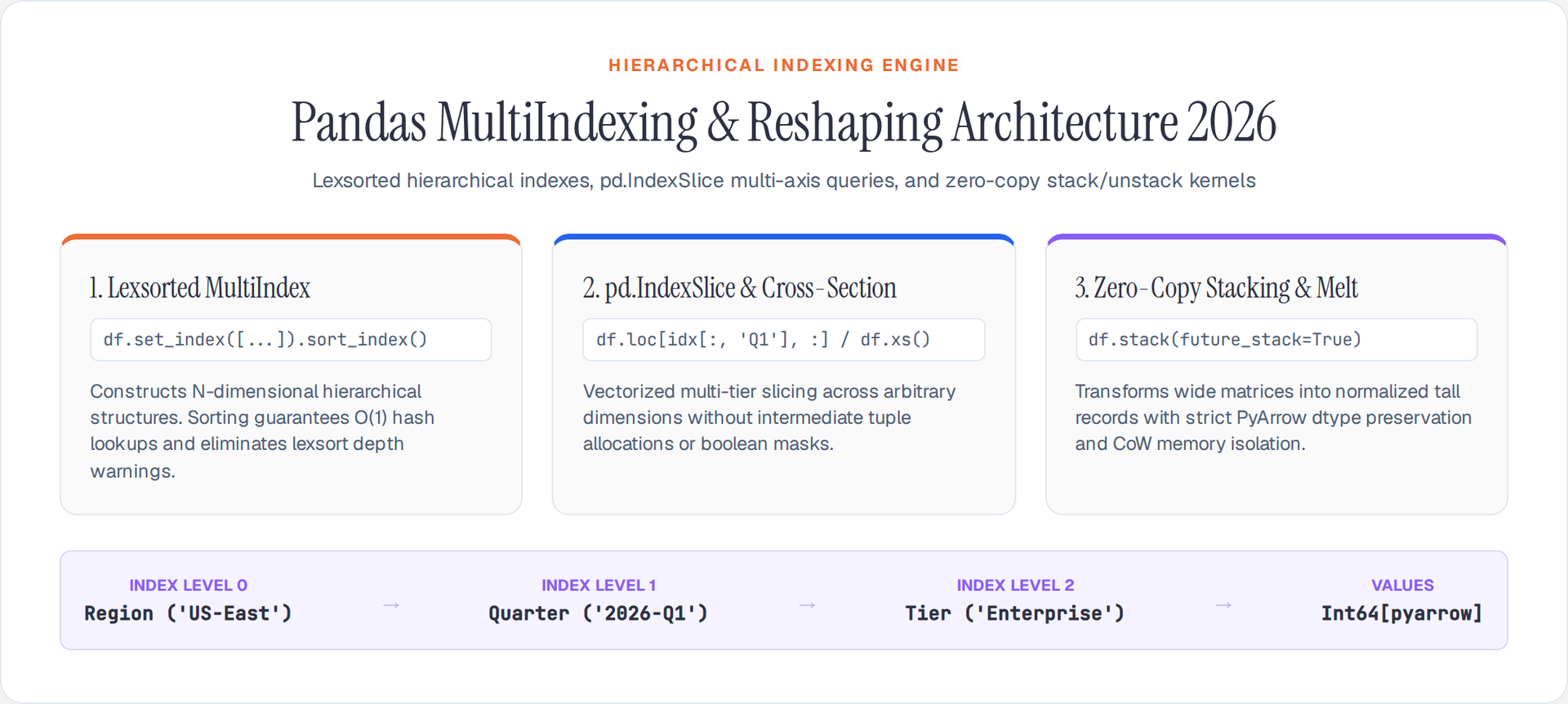
A MultiIndex allows DataFrames to represent 3D or higher-dimensional data in a standard 2D table format. To achieve fast lookups, hierarchical indexes must always be lexicographically sorted:
import pandas as pd
import numpy as np

# Create MultiIndex from Cartesian product
regions = ['US-East', 'US-West', 'EU-Central']
quarters = ['2026-Q1', '2026-Q2', '2026-Q3', '2026-Q4']
tiers = ['Enterprise', 'Mid-Market']

index = pd.MultiIndex.from_product(
    [regions, quarters, tiers],
    names=['region', 'quarter', 'tier']
)

# Initialize DataFrame with PyArrow numeric arrays
df = pd.DataFrame(
    {'revenue_k': np.random.randint(100, 1000, size=len(index))},
    index=index,
    dtype_backend="pyarrow"
)

# CRITICAL: Always sort MultiIndex for O(1) / O(log n) hash lookups
df = df.sort_index()
Performance rule: An unsorted MultiIndex forces Pandas to execute full linear scans (O(n)). Sorting with .sort_index() unlocks binary range lookups and eliminates PerformanceWarning: indexing past lexsort depth.
2. Advanced Multi-Level Slicing with pd.IndexSlice
Querying multi-tier indexes using standard brackets is error-prone. The pd.IndexSlice accessor provides clean, vectorized multi-axis slicing:
# Initialize IndexSlice selector
idx = pd.IndexSlice

# 1. Select specific tier across all regions and quarters
enterprise_all = df.loc[idx[:, :, 'Enterprise'], :]

# 2. Select US regions for Q1-Q2 across all tiers
us_h1 = df.loc[idx['US-East':'US-West', ['2026-Q1', '2026-Q2'], :], :]

# 3. Direct cross-section selection via .xs()
eu_data = df.xs(key='EU-Central', level='region')
Memory advantage: In Pandas 2.x with Copy-on-Write enabled by default, .loc[] and .xs() return views without duplicating underlying Arrow buffers until mutations occur.
3. Pivot Tables with Native PyArrow Types
The .pivot_table() method reshapes long-form event logs into aggregated multidimensional matrices:
# Sample event log
raw_events = pd.DataFrame({
    'timestamp': pd.date_range('2026-01-01', periods=1000, freq='h'),
    'server': np.random.choice(['srv-01', 'srv-02', 'srv-03'], 1000),
    'endpoint': np.random.choice(['/api/auth', '/api/query', '/api/checkout'], 1000),
    'latency_ms': np.random.exponential(scale=50, size=1000)
}, dtype_backend="pyarrow")

# Pivot table: Server vs Endpoint with multiple aggregate metrics
pivot_metrics = raw_events.pivot_table(
    index='server',
    columns='endpoint',
    values='latency_ms',
    aggfunc=['mean', 'p95', 'count'] if 'p95' in dir() else ['mean', 'max', 'count'],
    fill_value=0.0
)

print(pivot_metrics.head())
PyArrow category speedup: Storing categorical columns (server, endpoint) as string[pyarrow] or category accelerates pivot hashing by 4-6x compared to legacy Python object columns.
4. Stacking and Unstacking Without Downcasting
.stack() and .unstack() pivot DataFrames between wide columns and deep hierarchical index levels:
# Unstack the inner index level ('tier') to become columns
wide_df = df.unstack(level='tier')

# Stack columns back into the MultiIndex
# In Pandas 2.x, specify future_stack=True for zero-copy memory safety
tall_df = wide_df.stack(future_stack=True)
Modern syntax detail: Pandas 2.1+ introduced future_stack=True to resolve inconsistencies in dtype preservation and null handling, standardizing zero-copy reshape execution.
5. Wide-to-Long Melting and Demultiplexing
When ingesting spreadsheet data or wide analytics exports, pd.melt() and pd.wide_to_long() normalize columns into tidy, normalized records:
wide_data = pd.DataFrame({
    'account_id': [101, 102, 103],
    'rev_2024': [500, 600, 700],
    'rev_2025': [550, 680, 790],
    'rev_2026': [620, 750, 890]
}, dtype_backend="pyarrow")

# Melt columns into key-value pairs
melted = pd.melt(
    wide_data,
    id_vars=['account_id'],
    value_vars=['rev_2024', 'rev_2025', 'rev_2026'],
    var_name='fiscal_year',
    value_name='revenue'
)

# Strip prefix and convert to integer
melted['fiscal_year'] = melted['fiscal_year'].str.replace('rev_', '').astype('int64[pyarrow]')
6. Advanced Production Rules for 2026
- Always enforce lexsort order: Call
.sort_index()immediately after creating anyMultiIndexto ensureO(1)hash access. - Use
pd.IndexSliceinstead of chained tuples:df.loc[pd.IndexSlice[:, '2026-Q1'], :]avoids cryptic tuple indexing bugs. - Use
future_stack=Trueon.stack(): Eliminates silent upcasting bugs and maximizes PyArrow zero-copy performance. - Prefer flat tables with PyArrow categoricals for huge scale: When datasets exceed 100 million rows, flat tables with dictionary-encoded Arrow columns often outperform deep 5+ level MultiIndexes in distributed engines.
- Cross-section with
.xs(drop_level=False): When preserving hierarchy context is necessary during subgroup extractions.
Mastering MultiIndexing and multidimensional reshaping unlocks the full analytical power of Pandas 2.x, enabling expressive multi-axis queries with production-grade execution speed.
Author

Author