Best Python Books for Your First Step in 2026
The Python ecosystem in 2026 is vastly different from even a few years ago. With the rise of AI-assisted coding, new type-hinting features in Python 3.12+, and the shift toward production-ready machine learning, learning Python isn't just about syntax anymore—it's about learning the modern tooling and workflows.
While AI models can write snippets for you, understanding the architecture, reading the code, and debugging complex systems still require a deep foundational knowledge. Books remain one of the best ways to build that structured understanding without getting distracted by hype.
Here are the best Python books to take your first steps in 2026, categorized by what you actually want to achieve.
1. For the Complete Beginner: Python Crash Course
Author: Eric Matthes
Best for: Absolute beginners who want a balanced mix of theory and projects.
Python Crash Course remains the undisputed champion for first-time programmers. The latest editions have kept pace with modern Python features while retaining the accessible, no-nonsense approach that made the book famous.
The book is split into two halves. The first covers core concepts—variables, lists, dictionaries, classes, and testing. The second half throws you into three practical projects:
- A 2D game using Pygame.
- Data visualization using Matplotlib and Plotly.
- A web application using Django, deployed to a live server.
If you don't know where to start and just want a guided, comprehensive tour of what Python can do, this is your book.
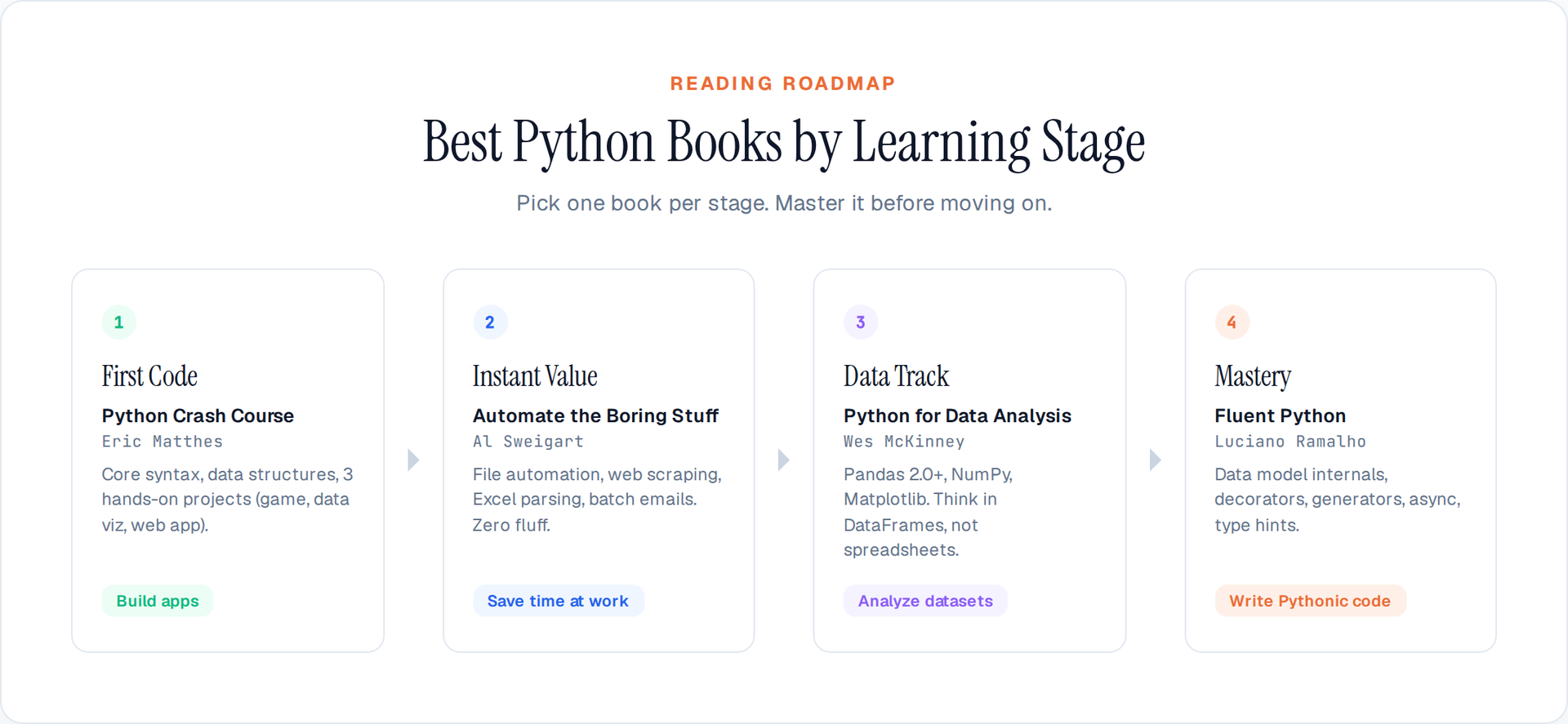
2. For Practical Instant Value: Automate the Boring Stuff with Python
Author: Al Sweigart
Best for: Office workers, administrators, and hobbyists who want Python to do their chores.
Not everyone wants to become a software engineer. Many people learn Python to make their day-job easier. Automate the Boring Stuff skips the abstract computer science theory and jumps straight into practical scripts.
Within the first few chapters, you'll be writing code that actually does things:
- Parsing messy Excel spreadsheets and CSV files.
- Scraping data from websites automatically.
- Reading and writing PDFs and Word documents.
- Sending batch emails and text messages.
In 2026, automating these tasks is still highly relevant, even with AI tools. Knowing how to write a script that connects APIs and cleans data continuously will instantly make you the most productive person in your office.
3. For the Data-Minded: Python for Data Analysis
Author: Wes McKinney
Best for: Aspiring data scientists and analysts moving away from Excel.
Written by the creator of the Pandas library, this book is the definitive guide to manipulating data in Python. The latest editions reflect the modern data stack, covering Pandas 2.0+ and its PyArrow backend, which drastically speeds up data operations.
You'll learn how to clean, reshape, and aggregate massive datasets that would crash Excel. The book also provides a solid foundation in NumPy (for numerical computing) and Matplotlib (for visualization).
While it assumes some basic Python knowledge, it teaches you how to think in terms of vectors and DataFrames—the core mental models required for modern data science.
4. For the AI-Curious: Deep Learning for Coders with fastai and PyTorch
Authors: Jeremy Howard & Sylvain Gugger
Best for: Developers who want to build real AI models, not just make API calls.
In 2026, calling an LLM API is easy, but actually understanding and training models requires specific skills. If you want to take your first step into real machine learning, this is the book.
Unlike traditional academic textbooks that bury you in calculus before letting you write code, this book takes a top-down approach. You will train a working image classifier in the very first chapter. From there, the book peels back the layers, explaining the math and architecture built on PyTorch and the fastai library.
You'll cover computer vision, natural language processing, tabular data, and recommendation systems, all with a focus on practical, production-ready implementation.
5. The Next Step: Fluent Python
Author: Luciano Ramalho
Best for: Developers who know the basics and want to write idiomatic, "Pythonic" code.
Once you know how to make Python work, the next step is learning how to make it work well. Fluent Python is not a beginner book, but it is the perfect "second book" after you finish one of the above.
It dives deep into the inner workings of the language. You will learn:
- How Python's data model works under the hood.
- Advanced usage of decorators, closures, and generators.
- Modern type hinting and static analysis.
- Concurrency with
asyncioand multiprocessing.
Reading this book marks the transition from "someone who writes Python" to a "Python Developer."
How to Choose Your Path
Don't buy all of them. Pick the one book that aligns closest with your immediate goals:
- Build applications? Python Crash Course.
- Save time at work? Automate the Boring Stuff.
- Analyze datasets? Python for Data Analysis.
Commit to reading it entirely and typing out the code yourself. In the era of AI-generated code, deep, structural understanding is your distinct professional advantage.
Author

Author