Best 10 Cloud GPU Providers in 2026: Ranked by Value and Performance
Cover Image
GPU compute is the most contested resource in cloud infrastructure. The AI training boom of 2024–2025 created massive capacity shortages, which drove new entrants into the market and forced the hyperscalers to dramatically expand their GPU fleets. In 2026, the market looks different: more supply, more price competition, and clearer differentiation between providers built for training versus inference.
This ranking focuses on actual value for ML workloads — not data center marketing. H100s are widely available now; what separates providers is network fabric quality, storage throughput, spot availability, and ecosystem tooling.
What to Evaluate Before Choosing a Provider
GPU generation and availability. H100 SXM5 80GB remains the benchmark for training. H200 (HBM3e, 141GB memory) ships from several providers and is meaningfully better for large-batch training. RTX 4090/A6000 for inference and fine-tuning.
Interconnect fabric. For multi-GPU training, NVLink within a node and InfiniBand between nodes matter as much as the GPU itself. A provider with 8x H100s connected via PCIe instead of NVLink delivers noticeably worse multi-GPU scaling.
Storage throughput. Training stalls on slow data loading. NVMe-backed storage or high-bandwidth object storage with low-latency mounting separates real ML infrastructure from repurposed VMs.
Spot/preemptible pricing. For training runs that support checkpointing, spot pricing reduces cost by 50–80% vs on-demand. Spot reliability (eviction rate and notice period) varies significantly.
Committed pricing. Reserved instances save 30–60% over on-demand for predictable inference loads. Some providers offer contract pricing that competes directly with hyperscaler 3-year reserved rates.
1. Lambda Labs — Best Value for Training
Lambda consistently offers the lowest on-demand H100 pricing among established providers. Their gpu_1x_h100_sxm5 instance at ~$2.49/hour beats AWS, GCP, and Azure by 40–50% for equivalent hardware.
Strengths:
- Lowest H100 on-demand rates in the market
- SXM5 interconnect (NVLink) on multi-GPU instances
- No egress fees for data transfer
- JupyterHub and simple API; SSH access by default
Weaknesses:
- Capacity can be constrained; H100 clusters sell out
- No spot/preemptible instances — on-demand only
- Less mature managed services compared to hyperscalers
Best for: Training runs where you SSH in, run experiments, and move on. Researchers and ML engineers who know what they want.
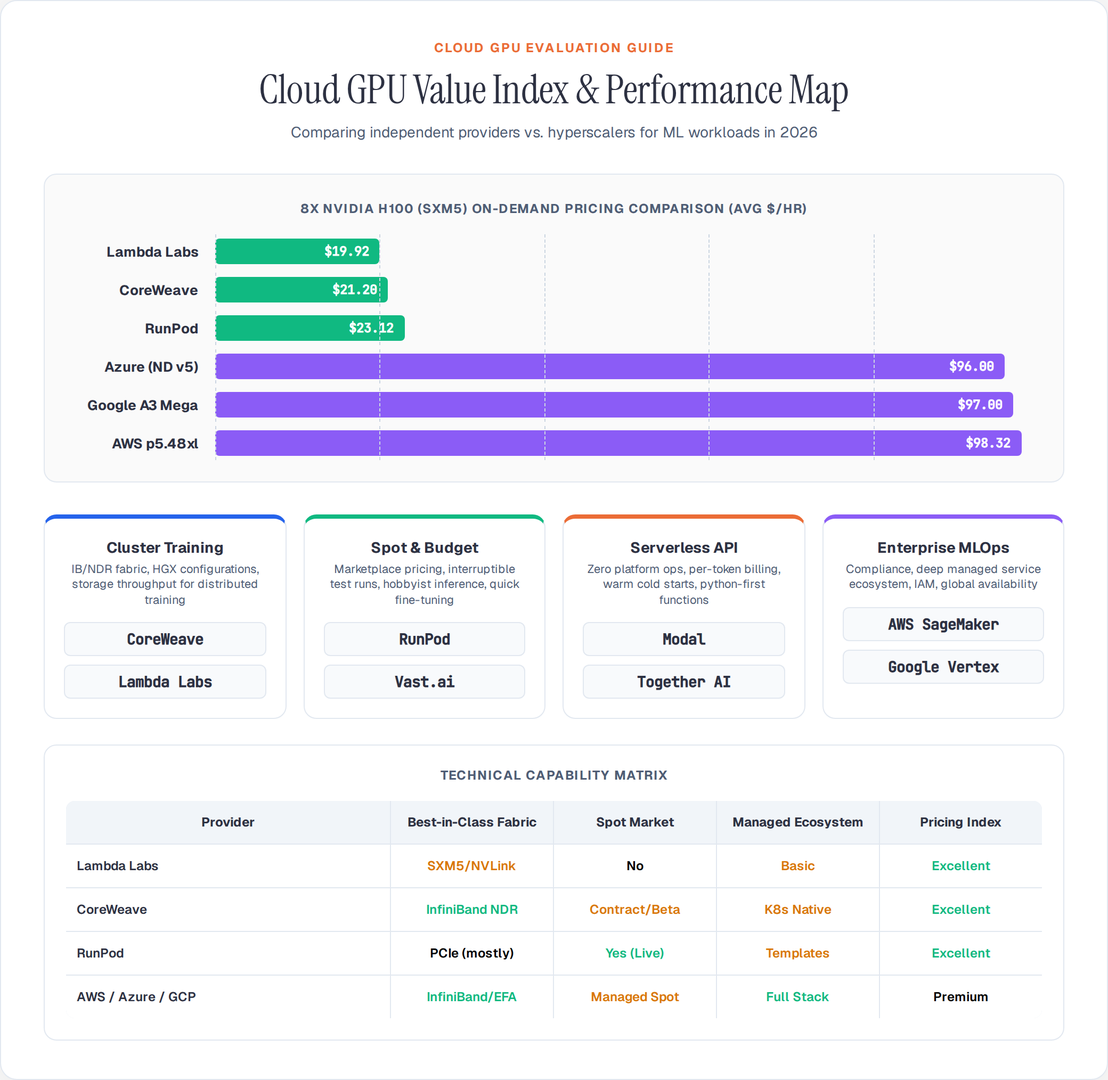
Pricing (2026): H100 SXM5 8x — ~$19.92/hr; A100 80GB 8x — ~$9.92/hr
2. RunPod — Best for Spot and Short Burst
RunPod's marketplace model aggregates GPU supply from multiple data center operators, creating a spot market with real-time pricing. H100 spot can drop under $2/hr during off-peak hours.
Strengths:
- Spot pricing genuinely competitive, often lowest available
- Wide GPU selection (H100, A100, 4090, 3090)
- Pod templates make setup fast
- Community-contributed containers for common ML stacks
Weaknesses:
- Spot eviction notice is short — checkpoint frequently
- Network bandwidth inconsistent across hosts
- Support response slower than hyperscalers
Best for: Fine-tuning runs, inference testing, experimental workloads that checkpoint every 15–30 minutes.
Pricing (2026): H100 spot from ~$1.80/hr; on-demand ~$2.89/hr
3. CoreWeave — Best for Large-Scale Training Clusters
CoreWeave built specifically for GPU compute with InfiniBand fabric, NVIDIA HGX configurations, and network designed for distributed training. They power training infrastructure for several frontier AI labs.
Strengths:
- Best-in-class multi-node interconnect (InfiniBand HDR/NDR)
- NVIDIA HGX H100/H200 with full NVLink
- Storage options include high-throughput NFS and object storage
- Kubernetes-native with NVIDIA Operator
- Reserved capacity contracts available
Weaknesses:
- Enterprise-focused; minimum commitments for best pricing
- Less self-service than Lambda or RunPod; sales process involved
- Not cost-competitive on small single-GPU workloads
Best for: Serious training clusters above 64 GPUs where interconnect quality directly impacts training efficiency.
Pricing (2026): H100 SXM5 ~$2.65/hr on-demand; cluster pricing negotiated
4. AWS (EC2 p4d/p5 + SageMaker) — Best for Enterprise MLOps
AWS offers the most mature ML ecosystem. p5.48xlarge (8x H100 SXM5) and p4d.24xlarge (8x A100) are production-proven. SageMaker handles training pipelines, experiment tracking, and model serving as managed services.
Strengths:
- Deepest managed ML tooling (SageMaker, Bedrock, service integrations)
- Spot instances available with Savings Plans
- Global availability zones
- IAM, VPC, and compliance certifications for regulated industries
Weaknesses:
- On-demand GPU pricing 40–60% higher than Lambda/RunPod for equivalent hardware
- Egress fees add up for large datasets
- SageMaker adds complexity that small teams don't need
Best for: Enterprise teams that need SageMaker pipelines, compliance certifications (HIPAA, SOC 2), and integration with existing AWS infrastructure.
Pricing (2026): p5.48xlarge (8x H100) ~$98.32/hr on-demand; Spot ~$30–40/hr
5. Google Cloud (TPU v5e/v5p + A3 VMs) — Best for TPU Workloads
GCP's A3 Mega instances (8x H100 SXM5) match AWS p5 on raw hardware but the real differentiator is Google's TPU lineup. TPU v5e and v5p offer better price-performance for specific model architectures (Transformer-heavy training) compared to H100s.
Strengths:
- TPU v5e/v5p unique performance advantage for JAX/Flax workloads
- A3 Mega with 3,200 Gbps GPU-to-GPU bandwidth
- Vertex AI for managed ML
- Strong Jupyter/Colab integration for research
Weaknesses:
- TPUs require JAX or adapted PyTorch XLA — not all models port easily
- GPU on-demand pricing comparable to AWS (expensive vs independents)
- TPU quotas can be difficult to obtain
Best for: Teams using JAX, research groups that benefit from TPU-specific performance, Google ecosystem users.
Pricing (2026): A3 Mega (8x H100) ~$97/hr; TPU v5e (4 chips) ~$12/hr
6. Vast.ai — Best for Budget Inference
Vast.ai is a peer-to-peer GPU marketplace. Individual operators list their hardware at prices they set. RTX 4090 for inference at $0.40–0.80/hr is genuinely unbeatable for cost-sensitive workloads.
Strengths:
- Cheapest inference hardware available (RTX 4090, A6000)
- Wide variety of GPU types
- Spot and on-demand both available
- Supports Docker containers; flexible environments
Weaknesses:
- Reliability varies by host — review uptime history before committing
- Not suitable for compliance-sensitive workloads
- Network location varies; latency unpredictable
- Support is community-based
Best for: Running inference workloads where cost-per-token matters more than SLA. Hobbyists and researchers on tight budgets.
Pricing (2026): RTX 4090 ~$0.40–0.80/hr; H100 ~$2.20–3.50/hr
7. Together AI — Best for Inference APIs
Together AI focuses on serverless inference rather than raw compute rental. 200+ open-source models available via API. No infrastructure management — pay per token, not per hour.
Strengths:
- Largest open-source model catalog (Llama 3.3, Mistral, Qwen, DBRX, etc.)
- Custom fine-tuned model deployment
- Competitive per-token pricing vs OpenAI for equivalent quality
- Serverless — no idle costs, no capacity planning
Weaknesses:
- Not useful for training or custom infrastructure
- Model selection limited to what Together offers
- Latency can vary under load
Best for: Teams that need open-source model inference without managing GPUs. Developers building applications on top of Llama or Mistral-class models.
Pricing (2026): Llama 3.1 70B ~$0.88/M tokens; custom deployment from ~$0.50/hr per GPU
8. Modal — Best for Serverless GPU Python
Modal lets you run Python functions on GPUs serverlessly — decorate a function, it runs on cloud hardware. No instance management, no Docker setup, no SSH.
Strengths:
- Best developer experience for Python ML engineers
- Scales to zero (no idle cost)
- Fast cold starts (~2–5 seconds for most images)
- Built-in secrets management, volumes, and schedules
Weaknesses:
- Higher per-GPU-hour cost vs raw instances (you pay for convenience)
- Not suitable for long-running training jobs
- Limited to Python-first workflows
import modal

app = modal.App("model-inference")
image = modal.Image.debian_slim().pip_install("transformers", "torch")

@app.function(gpu="H100", image=image, timeout=300)
def run_inference(prompt: str) -> str:
from transformers import pipeline
pipe = pipeline("text-generation", model="meta-llama/Llama-3.1-8B-Instruct")
return pipe(prompt, max_new_tokens=200)[0]["generated_text"]
Best for: ML engineers who want to iterate fast on GPU workloads without infrastructure overhead.
Pricing (2026): H100 ~$4.00/hr; A100 ~$2.80/hr (billed per second)
9. Paperspace (now DigitalOcean GPU) — Best for Notebooks and Education
DigitalOcean acquired Paperspace, integrating Gradient notebooks into their platform. Good entry-level option for teams already in the DigitalOcean ecosystem and for notebook-first workflows.
Strengths:
- Integrated with DigitalOcean billing and team management
- Gradient notebooks with persistent storage
- Good A100 availability
- Simple UI; low barrier to entry
Weaknesses:
- H100 availability limited compared to dedicated providers
- Pricing not competitive with Lambda or RunPod for equivalent hardware
- Less feature depth than AWS/GCP managed services
Best for: DigitalOcean customers, small teams starting with GPU workloads, notebook-heavy research workflows.
Pricing (2026): A100 80GB ~$3.18/hr; H100 (when available) ~$4.50/hr
10. Azure (ND H100 v5) — Best for Microsoft Ecosystem
Azure's ND H100 v5 VMs (8x H100 SXM5 with 3,200 Gbps InfiniBand) are production-grade. The real value is Azure AI Foundry integration and compatibility with Microsoft's enterprise stack.
Strengths:
- Strong Azure OpenAI and Azure ML integration
- InfiniBand HDR for multi-node training
- Enterprise compliance (FedRAMP, HIPAA, SOC 2)
- Spot VM pricing available
Weaknesses:
- On-demand pricing comparable to AWS — expensive vs independents
- GPU availability varies by region
- Azure ML adds complexity
Best for: Microsoft-ecosystem enterprises, Azure OpenAI customers, regulated industry workloads requiring Azure compliance certs.
Pricing (2026): ND96isr H100 v5 (8x H100) ~$96–100/hr on-demand
Cost Comparison: H100 8x Instance by Provider (2026)
| Provider | H100 8x On-Demand | H100 8x Spot | Notes |
|---|---|---|---|
| Lambda Labs | ~$19.92/hr | N/A | No spot; best on-demand |
| RunPod | ~$23.12/hr | ~$14–18/hr | Spot varies live |
| CoreWeave | ~$21.20/hr | ~$13–16/hr | Contract pricing better |
| AWS p5 | ~$98.32/hr | ~$30–40/hr | Savings Plans available |
| GCP A3 Mega | ~$97/hr | ~$28–35/hr | Committed use discounts |
| Azure ND v5 | ~$96–100/hr | ~$25–40/hr | Reserved pricing available |
Decision Framework
Training research / academia: Lambda Labs (best price), RunPod (spot for checkpointing runs)
Production training at scale: CoreWeave (interconnect), AWS/Azure/GCP (compliance + ecosystem)
Inference APIs: Together AI (serverless, zero infra), Modal (Python-first serverless)
Budget fine-tuning / inference: Vast.ai, RunPod spot
Enterprise MLOps: AWS SageMaker, Google Vertex AI, Azure ML
Notebook-first: Paperspace/DigitalOcean, Google Colab Pro+
The gap between hyperscaler and independent provider pricing for raw compute has not closed. Lambda and RunPod offer H100 access at 4–5x lower on-demand cost than AWS/GCP/Azure. For teams that don't need hyperscaler managed services or compliance certifications, the independents deliver significantly better value per GPU-hour.