Best Web Scraping APIs 2026: Which One Actually Delivers?
Cover Image
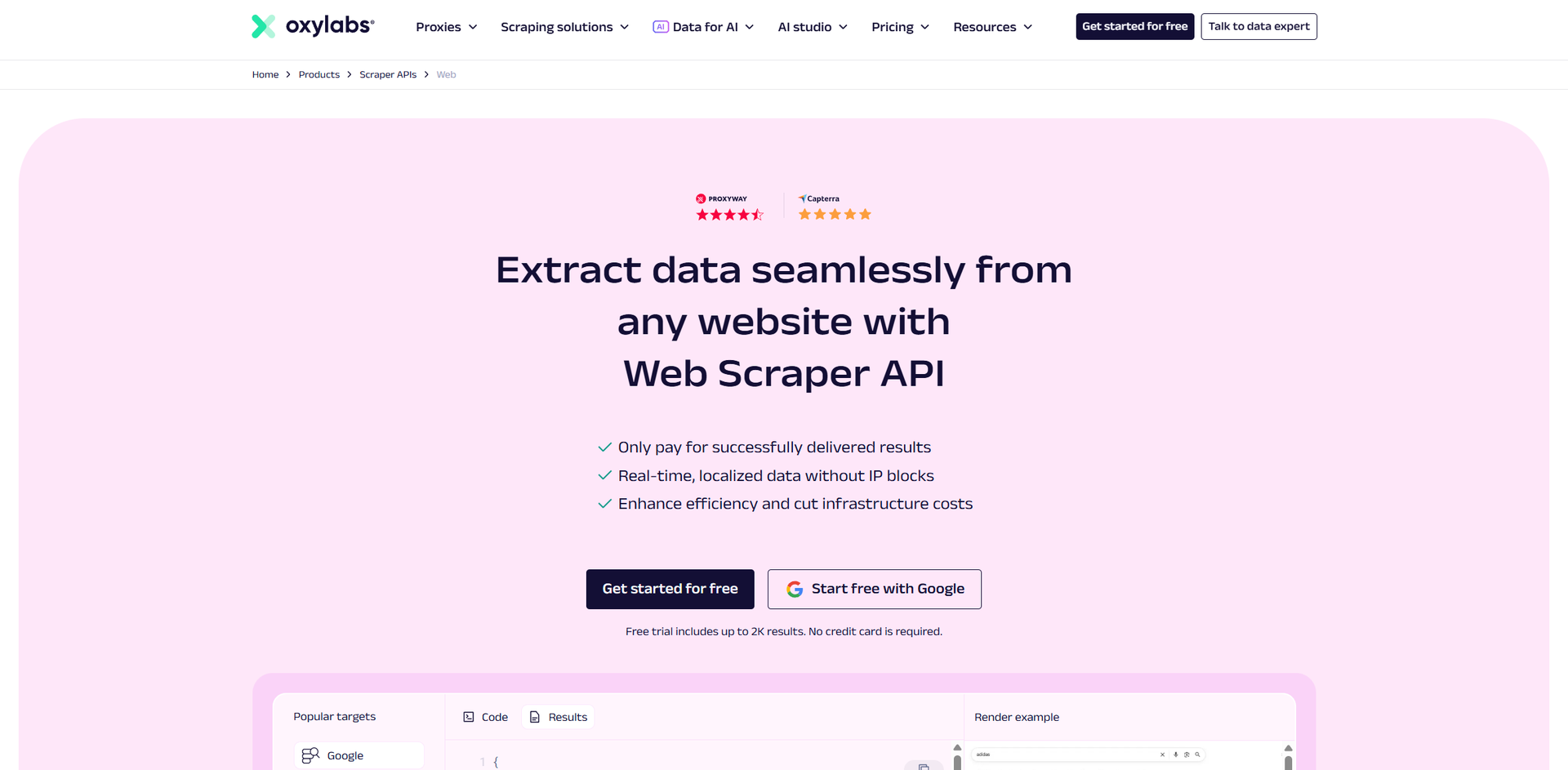
Web scraping project success depends entirely on API choice. Wrong pick = endless CAPTCHA fights, IP blocks, proxy failures. Right pick = smooth scaling from hundreds to millions of requests.
The scraping API market matured significantly in 2026. Price wars evolved into AI-powered parsing competition, zero-config extraction, infrastructure that handles JavaScript-heavy sites at real scale.
This breakdown covers best web scraping APIs by what they deliver for actual projects, not marketing fluff.
What Is a Web Scraping API?
Web scraping API sits between your code and target website. Send simple API request, get structured data back. No custom scrapers, proxy management, retry logic.
API handles messy infrastructure: proxy rotation, CAPTCHA solving, session management, browser fingerprinting, rate limiting. You focus on data usage, not extraction mechanics.
For teams needing reliable data extraction without dedicated scraping engineering, these APIs became essential. Market spans simple HTTP endpoints for static pages to full browser automation clouds executing client-side JavaScript.
Why Reliable Scraping APIs Matter More in 2026
Modern websites harder to scrape than ever. SPAs dominate, anti-bot systems standard, AI-generated content makes structured data recognition complex.
Data demand exploded. E-commerce intelligence, competitor monitoring, SEO analysis, financial aggregation — all need consistent, scalable pipelines. Flaky scraper blocked 30% = worse than useless. Creates data gaps undermining entire analysis.
Selected APIs based on reliability, feature depth, pricing transparency, real-world performance across common use cases.
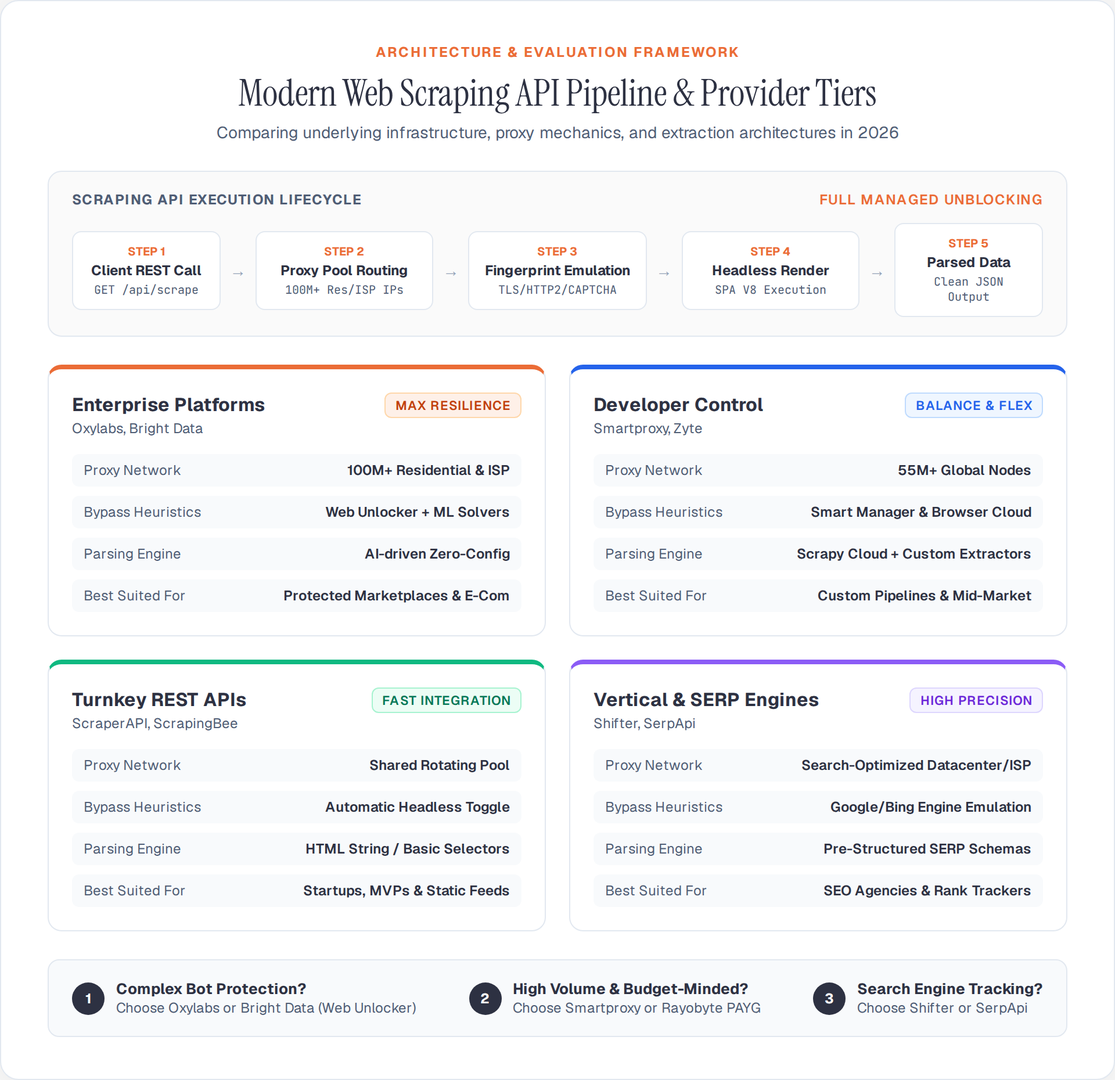
Oxylabs — Best Overall Web Scraping API
Oxylabs built comprehensive web data platform. Web Scraper API handles static pages to complex JavaScript applications. Strong single-vendor choice for multiple use cases.
Key features:
- Residential, datacenter, ISP proxies with global coverage
- AI-powered parser extracts structured data without custom selectors
- Automatic CAPTCHA and antibot circumvention
- JavaScript rendering for SPAs
- Real-time and scheduled data collection
- Custom scraper templates for common use cases
AI parser particularly noteworthy. No XPath or CSS selectors required — ML identifies and extracts data fields automatically. Product listings, job boards, real estate pages, structured data at scale = significant development time reduction.
Premium pricing, but enterprise teams needing reliability + global coverage get consistent delivery. Proxy pool genuinely large — 100M+ IPs. Matters for high-volume scraping where IP diversity directly impacts success rates.
Best for: Enterprise data extraction, e-commerce intelligence, market research, SEO monitoring at scale.
Bright Data — Fastest Web Scraping API
Bright Data (formerly Luminati) operates largest proxy networks globally. Scraping API built around speed without sacrificing reliability. Web Scraper API integrates directly with proxy infrastructure creating unified extraction system.
Key features:
- Proprietary antibot bypass technology
- Real-time extraction with sub-second response times
- SERP API for search engine result scraping
- E-commerce, social media, travel-specific scrapers
- Web Unlocker for aggressive bot protection sites
- Full browser automation for JavaScript-heavy sites
Web Unlocker deserves special mention. Uses fingerprint management + automated browser rendering to access sites blocking most automated requests. LinkedIn, Instagram, major e-commerce platforms actively resisting scraping = often difference between data and blocks.
Used by major corporations, research institutions. Speaks to reliability. Tradeoff = complexity. Steeper learning curve than simpler alternatives, pricing reflects enterprise positioning.
Best for: Real-time data extraction, competitive intelligence, large-scale SERP monitoring, scraping protected websites.
Smartproxy — Best Value for Quality
Smartproxy carved strong position delivering reliable scraping infrastructure without enterprise budgets. Small-medium teams needing professional-grade tools without enterprise price tags.
Key features:
- Residential, datacenter, mobile proxies
- No-code scraper templates for common use cases
- SERP scraper optimized for search engine data
- Geotargeting down to city-level in 195+ countries
- Competitive pricing with generous request limits
Scraping Browser standout feature. Provides headless browser environment handling JavaScript rendering + antibot detection automatically. Connect via simple API, get structured data back without managing browser infrastructure.
Platform expanded significantly beyond proxies into complete scraping solutions. Dedicated APIs for e-commerce, real estate, business data. Teams wanting scalable solution without custom scrapers = fast path to production.
Best for: Startups, small teams, e-commerce scraping, budget-conscious quality-focused projects.
Zyte — Best for Developer Control
Zyte (formerly Scrapinghub) built reputation on open-source Scrapy framework. Evolved into full scraping platform. Focus on developer experience — powerful tools for teams knowing their requirements.
Key features:
- Smart Proxy Manager with automatic retry + IP rotation
- Automatic Form Extraction
- Zyte API for JavaScript rendering + data extraction
- Scrapy Cloud for distributed crawlers
- Custom extraction logic alongside automated parsing
Different approach from turnkey solutions. Gives building blocks — proxies, rendering, extraction — compose for specific needs. Appeals to engineering teams wanting flexibility over opinionated black-box solutions.
Pricing model attractive for variable workloads. Pay for usage rather than monthly minimums. Makes Zyte practical for fluctuating scraping demands.
Best for: Developer teams, custom scraping pipelines, open-source enthusiasts, complex extraction logic projects.
ScraperAPI — Best for Beginners
ScraperAPI remains most accessible web scraping API. Value proposition straightforward: send URL, get clean HTML with needed data.
Key features:
- Simple REST API — one endpoint, no configuration needed
- Automatic proxy rotation + CAPTCHA handling
- JavaScript rendering available
- Geolocation targeting
- 1,000 free API calls monthly
Developers getting started with scraping or teams needing simple, reliable tool for basic tasks = hard to beat. No complex setup — point API at URL, handles rest. Free tier generous enough for proper service evaluation.
Tradeoff = depth. No advanced enterprise platform features, smaller proxy pool. Simple high-volume scraping of accessible sites performs well. Heavily protected targets or complex JavaScript applications eventually hit limitations.
Best for: Beginners, simple scraping projects, prototyping, developers needing quick solution without infrastructure setup.
Shifter — Best for SERP Data at Scale
Shifter specialized in SERP (Search Engine Results Page) scraping. Built APIs reliably extracting Google, Bing, other search engines without blocks or CAPTCHAs.
Key features:
- Dedicated SERP API with Google + Bing support
- Mobile + desktop search emulation
- Localized results by city, state, country
- Unlimited bandwidth on select plans
- Competitive pricing for high-volume SERP monitoring
Primary need = tracking search rankings, monitoring competitor positions, aggregating search data. Shifter's focused approach delivers better results than general-purpose scraping APIs. Infrastructure specifically optimized for search engine scraping = higher success rates + more accurate data.
Unlimited bandwidth offering on certain plans unusual in market. Valuable for teams running continuous SERP monitoring without watching request counts.
Best for: SEO agencies, SERP monitoring, rank tracking tools, marketing intelligence.
Rayobyte — Best for Pay-As-You-Go Scraping
Rayobyte operates largest US-based proxy networks. Expanded into scraping APIs with flexible no-commitment pricing appealing to teams with irregular scraping needs.
Key features:
- Residential, datacenter, ISP, mobile proxies
- Web Scraping API with automatic rotation
- Pay-as-you-go pricing without monthly minimums
- Web Unblocker for protected sites
- Headless browser scraping
Pricing flexibility sets apart. Unlike competitors requiring monthly subscriptions, Rayobyte offers genuine pay-per-use options. Viable for sporadic or unpredictable scraping demands. Matters for teams needing professional infrastructure without annual contract locks.
Proxy network includes 40M+ residential IPs. Provides diversity needed for large-scale data collection. US infrastructure focus worth noting — needing proxies concentrated in American IP space = strongest offerings available.
Best for: Variable workload teams, US-focused scraping projects, flexible billing preference.
Decision Framework
Choose Oxylabs or Bright Data for enterprise-grade reliability, global coverage, willing to pay premium. Tools handling mission-critical data pipelines.
Choose Smartproxy for quality infrastructure at mid-market pricing. Sweet spot for growing teams outgrowing basic tools but not needing full enterprise contracts.
Choose Zyte for developer control over scraping logic, comfortable composing pipeline from reliable components.
Choose ScraperAPI for getting started, simple needs, straightforward scraping not justifying complex tooling.
Choose Shifter for core SERP data needs. Dedicated tools outperform general-purpose in domain.
Choose Rayobyte for flexible pay-as-you-go pricing + US-focused proxy infrastructure.
Common Scraping Mistakes to Avoid
No matter API choice, these mistakes undermine data quality:
Ignoring rate limits. Best APIs have limits. Respect them or risk throttling/temporary blocks.
Not handling session consistency. Some data requires maintaining same session across requests. Choose APIs supporting session persistence if targets require login or stateful browsing.
Skipping error handling. Failed requests happen. Build pipeline detecting, logging, retrying failures rather than silently dropping data.
Extracting without parsing. Raw HTML useless without structure. Use APIs with built-in parsing or build extraction logic carefully.
Forgetting geolocation requirements. Need location-specific data = verify API supports required geographic targeting before committing.
For browser automation instead of per-request payment, our Playwright vs Puppeteer comparison covers full browser control. After data flows, Google Maps scraping for leads shows turning raw listings into pipeline.
Conclusion
Web scraping API market in 2026 offers genuinely capable tools for every scale + budget. Gap between "simple proxy service" and "complete data platform" widened considerably. Right choice depends heavily on specific needs.
Most teams decide on: engineering resource availability + data criticality. More engineering resource + higher stakes = Oxylabs or Bright Data. Lean teams with straightforward needs find excellent value in Smartproxy or ScraperAPI.
Whatever chosen, invest time understanding rate limits, geolocation options, parsing capabilities before committing to volume pricing. Tool looking cheapest on paper often costs more factoring engineering time working around limitations.
Ready to start building? Pick API matching current scale. Real test with actual target sites before scaling up.