Data Labeling Services: Where Outsourced Labeling Breaks
Cover Image

Buy a labeling workflow you can inspect
Data labeling services turn raw examples into annotations: categories for text, boxes around objects, transcripts for audio, or ratings of model responses. Before comparing quotes, define what a usable annotation looks like, who resolves uncertain cases, and how you will check the delivered data. A low price per task tells you little if the export cannot enter your training pipeline or the labels follow a different interpretation of your instructions.
Outsourcing works best as a documented handoff. Your team owns the task definition and acceptance criteria. The provider supplies the agreed workforce, tooling and review process. You need enough visibility to identify a problem, correct it and decide whether earlier batches are affected.
This guide explains how to evaluate that handoff, run a meaningful pilot and compare managed services with platforms and an internal team.
Define the deliverable before asking for a price
Describe the task in terms of the data you need back. For a document classifier, that could be a stable document ID, a category and a review status. For object detection, specify which objects count, how to handle occlusion, and the required coordinate format. For response ratings, define the rubric and how to record a tie or an unanswerable comparison.
Ask the provider to return a small export using your proposed schema before quoting the full job. Inspect how it represents missing labels, multiple annotations, corrected results and the connection to each source item. Label Studio's export documentation, for example, describes several task-dependent formats. Support for an export format is not proof that it matches your pipeline's conventions.
The statement of work should identify:
The task, label definitions and examples of borderline cases.
The input and output schema, including stable IDs and required metadata.
The roles responsible for annotation, review and final adjudication.
The quality checks, acceptance rules and handling of rejected batches.
The process for instruction changes, rework and delivery delays.
Request an itemized quote for initial annotation, review, adjudication and corrections. Confirm which activities are included in the unit price. Compare providers against the same task definition so a cheaper proposal does not quietly omit part of the work.
Where outsourced labeling can break
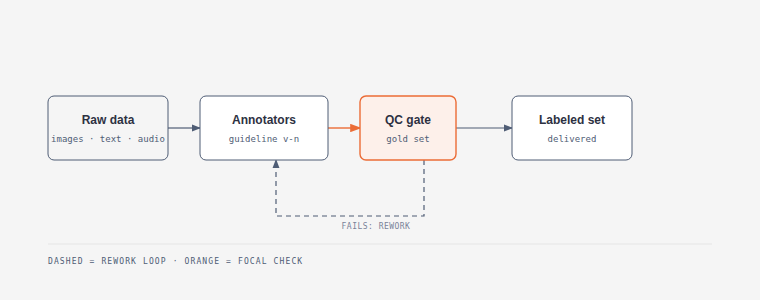
Treat the following as failure modes to test during a pilot, rather than assumptions about every vendor.
Failure mode | What you might observe | What to check |
|---|---|---|
Ambiguous instructions | Similar examples receive different labels | Boundary examples and the escalation route |
One headline quality score | The overall result looks good while a rare class fails | Results by class, data source and difficult case |
Weak correction process | Errors are identified but remain in delivered files | Who edits labels and how corrected exports are versioned |
Undocumented instruction changes | Older and newer batches use different meanings | Guideline versions tied to individual batches |
Workforce changes | New annotators interpret established examples differently | Training, calibration and reviewer continuity |
Export mismatch | The data looks correct in the tool but fails import checks | A real export processed by your own pipeline |
A speed target or payment arrangement is something to investigate, not evidence that a provider is gaming its metrics. Ask how annotators are evaluated, how much review work the schedule allows, and what happens when an item takes longer than expected. Check the answers against pilot results.
Likewise, do not assume every label change is quality drift. A revised guideline can intentionally change the answer. The important distinction is whether the change is documented and whether the delivered batch identifies the applicable instructions.
Measure agreement and correctness separately
Inter-annotator agreement asks whether people label the same item consistently. Reference-label evaluation asks whether their results match a reviewed answer. Both are useful, but agreement alone cannot establish that the shared interpretation is the one your application needs.
Imagine that every annotator follows an instruction that incorrectly excludes partially hidden objects. Their boxes could agree while still missing the examples your model needs to detect. That hypothetical case is a reason to review the specification as well as the annotations.
Choose the metric for the task. An exact category match answers a different question from the overlap between two bounding boxes. Label Studio Enterprise's agreement-metric documentation distinguishes exact matching, span overlap and intersection over union, among other approaches. Ask a vendor which calculation it uses, how it handles missing annotations, and what its reported denominator includes.
Build a reviewed reference set
Have qualified reviewers create or adjudicate reference labels for examples that cover the decisions your model must make. Include straightforward items and difficult cases. Record why each answer was chosen, and define how reviewers should handle genuine ambiguity.
Keep the final evaluation subset separate from examples used to teach the task. Calibration examples help annotators learn your definitions; evaluation examples help you assess whether that learning transfers. Do not give the provider the answer key to the held-back evaluation set.
For subjective ratings, preserve uncertainty or multiple defensible judgments when the task requires them. Label Studio's consensus tutorial illustrates overlap between annotators and targeted review of disagreements. Use disagreement to locate cases that need a decision, rather than automatically treating the majority answer as correct.
Specify review and correction as separate steps
A reviewer saying that a label is wrong does not necessarily produce a corrected annotation. Ask who makes the edit, who approves it and which delivery contains the corrected result.
As a concrete tooling example, AWS documents distinct label-verification and label-adjustment workflows for supported Ground Truth tasks. Verification generally rates or comments on existing labels; adjustment changes prior annotations. The documentation notes that Ground Truth is available to existing customers rather than new ones. The distinction between judging an answer and correcting it is useful whichever provider or tool you choose.
Run a pilot that tests the whole handoff
Use a paid pilot to test the proposed production workflow, including instructions, annotator training, review and export. Choose its size and composition around the task's variation and your ability to audit the results. A fixed item count is not a universal guarantee of a representative sample.
Freeze a guideline version and agree on the output schema.
Select examples covering common cases, rare classes and known ambiguities.
Run annotation with the proposed training and review process.
Audit a random sample and separately inspect the difficult cases.
Adjudicate disagreements and document their causes.
Request corrections, then verify that the corrected export contains them.
Load the export through your pipeline and evaluate the intended downstream use.
Keep random-sample results separate from a deliberately difficult challenge set. The random sample and challenge set answer different questions; combining them into one unqualified percentage can obscure which cases the service handles well.
Define the acceptance rule before reviewing the pilot. It should specify the metric, evaluated examples, reviewer process and consequences of failure. A task involving rare but costly mistakes may need class-specific checks rather than one overall accuracy threshold. Set those requirements from your application, not a vendor's default dashboard.
If a pilot fails, distinguish a labeling mistake from an unclear instruction or a tool limitation. Correct the cause, repeat the affected work and inspect a fresh batch before increasing volume.
Ask how the workforce will be trained and retained
Ask who will perform the work, how expertise is assessed, whether training is paid, and how annotators can challenge unclear instructions or rejected tasks. Request a plan for onboarding replacements and preserving reviewer knowledge when a project changes.
There is evidence of difficult working conditions, but it should be used with its scope intact. In fieldwork reported on August 24, 2026, University of Melbourne researcher Fan Yang described interviews with ten workers in China and Australia and reported general-task pay as low as A$6 per day or less. That small, ongoing interview study is not a market-wide pay benchmark or proof that a particular vendor's labels are unreliable.
Use the concern to ask concrete questions about working arrangements and continuity. Agree on what reporting you need, such as pseudonymous annotator or team IDs, reviewer assignments and training completion. Do not judge a worker from one aggregate score without examining the assigned tasks, guideline version and reviewer decisions.
Compare service models by what your team can own
The choice depends on which parts of the workflow your team can manage and which judgments require specialist expertise.
Model | What to establish before choosing it |
|---|---|
Managed service | Who recruits, trains, reviews and corrects the work, and what evidence you receive |
Self-serve platform | Whether the proposal includes a workforce or only software, and who operates the queue |
Internal team | Whether you can staff annotation, domain review and delivery management |
Hybrid arrangement | Which team owns guidelines, adjudication and acceptance while the vendor handles agreed tasks |
Domain-sensitive work calls for an explicit qualification and review plan. Do not assume an internal team is automatically more accurate, or that every managed service lacks the expertise you need. Test the proposed people and process against your own examples.
Put acceptance and rework in writing
Before scaling, document what will happen when a batch falls short. Specify who investigates, who pays for corrections under the agreed terms, and how you receive a replacement export without losing its history.
Tie every batch to its source IDs, label schema and guideline version.
Define audit access and the information needed to reproduce quality scores.
Record when a guideline change requires earlier labels to be revisited.
Confirm handling of data access, retention, deletion and subcontractors.
Set a process for workforce changes, missed delivery dates and escalation.
Test the final export and retain the acceptance record with it.
Approve the service when the pilot demonstrates the handoff you intend to buy: interpretable labels, a usable export and a correction process you can follow. Keep the reviewed reference set and the decision history available as production continues. They give your team something concrete to check when a later batch changes.