LLM fine-tuning dataset quality: 6 checks before training
Cover Image

A fine-tuned model scores well on the test set. Then someone finds that several test questions are rewrites of training examples, with the same source passages and answers. The score still describes what happened on that test, but it no longer supports the claim that the model handles unfamiliar material.
LLM fine-tuning dataset quality starts before the training job. You need valid examples, a policy for repeated content, and splits that match the capability you intend to measure. Removing exact duplicate rows helps, but it does not catch every paraphrase, shared source, or answer copied into an input field.
This guide describes six checks for a supervised fine-tuning dataset, including duplicate review, group-based splitting, and release documentation. It does not report a training experiment or promise a score improvement. The goal is to make the dataset's decisions inspectable so you can distinguish a model problem from an evaluation problem.
Start by defining what one acceptable example contains.
1. Define the contract for LLM fine-tuning dataset quality
Choose the format your trainer actually consumes. A chat dataset may contain ordered messages and role fields; a completion dataset may use separate prompt and response fields. Tool-use and multimodal examples need different validation from plain text conversations. A generic "valid JSON" check is not enough.
Validate required fields, types, allowed roles, and the relationships between messages. Check that the intended assistant response receives training loss under your trainer's masking configuration. A syntactically valid example can still supervise the wrong span or include no usable target at all. See the official documentation for these implementation details.
Inspect the rendered training sequence too. Chat templates can add separators and control tokens that are absent from the stored row. Measure length with the actual tokenizer and template, then define what happens to examples beyond the supported sequence length. Silent truncation can remove the answer or the context needed to justify it. See the official documentation for these implementation details.
Check | Example of a failure worth recording |
|---|---|
Structural validity | A response field has the wrong type |
Conversation semantics | A tool result has no matching call |
Training target | Masking removes every intended response token |
Length handling | Truncation drops the reference passage |
Provenance | An example has no traceable source or generation record |
Check response quality against the task's rubric as well. Review factual support, label definitions, and ambiguous cases with someone who understands the domain. Valid roles and types cannot tell you whether a target answer is correct. Record adjudication decisions so the same disputed case does not receive different labels on the next run.
Keep stable example IDs and reason codes for rejected or held rows. Avoid copying sensitive prompt text into routine validation logs. Record enough information to locate an example in controlled storage instead.
A contract establishes what the pipeline can process. It does not decide whether two acceptable rows teach the same thing, which is the next check.
2. Separate exact duplicates from conflicting examples
Define what "exact" means before computing fingerprints. Byte-identical source files, identical serialized training examples, and identical prompts are different comparisons.
For training-example deduplication, serialize the fields that determine the model input and target in a stable order. Include relevant system instructions, roles, and context rather than hashing the final answer alone. Preserve a separate source identifier so you can trace where matching examples originated.
Normalization is a policy choice. Standardizing line endings may remove irrelevant differences in prose, but deleting punctuation or collapsing whitespace can change code and other structured tasks. Version the normalization rules and inspect their effects before using them to remove records.
A hash groups candidate matches efficiently. Where exact identity matters, confirm the canonical content matches before removing a row. A fingerprint is not evidence that the example is correct, permitted for use, or free of personal information.
Compare prompts separately to detect conflicts. The same input paired with incompatible target labels needs review. Two different responses to the same prompt are not automatically contradictory: an open-ended writing task may permit both. Apply the task's label or response policy instead of keeping whichever row was ingested first.
Repeated examples can also affect the training distribution. Decide whether to remove them, cap their frequency, or retain intentional repetition with documented weights. Deleting every repeated answer would remove legitimate examples from classification tasks where many inputs share one label.
Once exact matches and conflicts have names, near-duplicate review becomes easier to reason about.
3. Use near-duplicate detection to find candidates
Near-duplicate methods identify resemblance according to a representation. They do not decide whether two examples are interchangeable for learning or evaluation.
For text overlap, word or character shingles are one option. The datasketch MinHash documentation describes estimating Jaccard similarity between sets. In a text pipeline, those sets might contain shingles. The estimate depends on that choice of input and the signature configuration; it is not a measure of answer correctness or semantic equivalence.
Locality-sensitive hashing can narrow the candidate pairs you compare at scale, but it is approximate. Measure missed matches and false matches on reviewed examples. For a small corpus, direct comparison may be simpler than maintaining a separate approximate index. See the official documentation for these implementation details.
Shared scaffolding needs special care. A long common instruction can dominate overlap while the meaningful question changes. Compare task content separately from boilerplate where appropriate, but keep the full training sequence available for inspection. Removing the scaffolding from the comparison must not erase instructions that change the task.
Embedding similarity can surface paraphrases that lexical matching misses. It can also place distinct questions close together because they discuss the same topic. Select thresholds using labeled pairs from your own task; do not treat a similarity score as a universal removal rule.
For synthetic examples, record the source seed, generation template, and transformation lineage. A large row count may hide a narrow set of repeated patterns. Inspect diversity by source and task as well as by distinct strings.
Review should produce two decisions: which examples to retain, and which relationships must constrain splitting. Those decisions need not be identical. Useful paraphrases may remain in the dataset while staying together in one split.
4. Split related examples together
Choose the split unit from the evaluation question. If you want to measure performance on unseen source documents, keep all examples derived from one document in the same split. If you want to generalize to new customers, products, or template families, those relationships may determine the grouping instead. Use stable internal group IDs rather than exposing personal identifiers.
A random row split is like giving someone a practice exam and then moving a few reworded questions onto the final. The questions are different strings, but the final no longer tests unfamiliar material in the way you intended.
Consider this illustrative dataset, not measured project data:
Example | Origin | Split constraint |
|---|---|---|
An original question about policy A | Source document A | Keep with other A-derived examples |
A paraphrase of that question | Same seed and source | Keep with the original |
A question about policy B | Source document B | Can be assigned independently unless a required relationship links it |
When several relationships matter, handle their overlap. A duplicate pair can connect two source groups. Treat connected examples as one assignment unit when the policy requires every such relationship to stay inside a split. Inspect unexpectedly large components: a boilerplate match can join much of the corpus and make the intended evaluation impossible.
Scikit-learn's GroupShuffleSplit documentation describes splitting by caller-provided groups. Its size parameters refer to groups, not rows. Unequal group sizes can therefore produce different row proportions from what you expected. Also, repeated random splits do not guarantee mutually exclusive test sets across iterations; do not mistake those iterations for one permanent train, validation, and test partition.
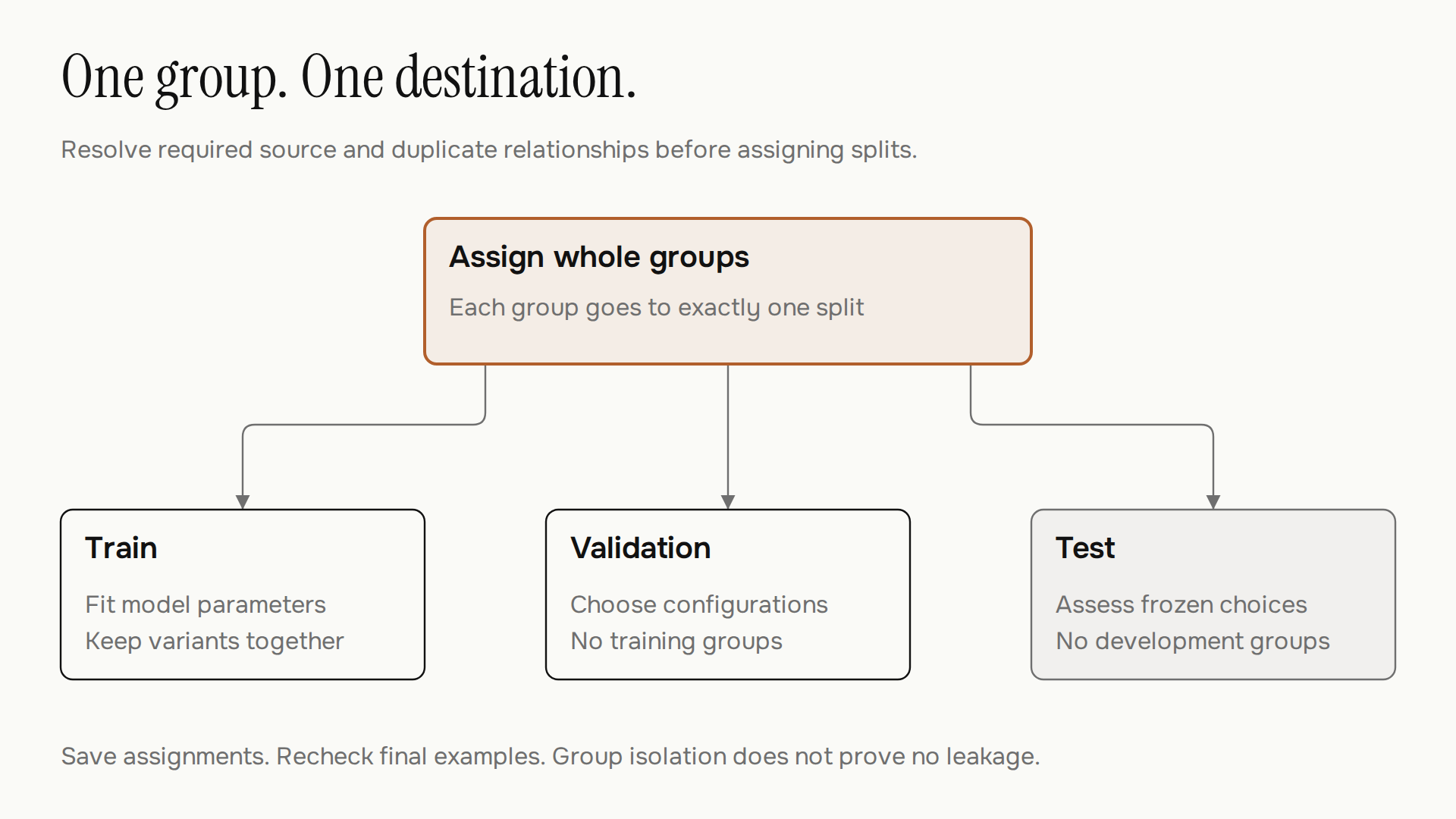
For a fixed release, save one explicit assignment manifest and verify that no required group crosses its boundaries. The diagram shows that constraint, not a recommended split ratio. Check label, language, and task coverage afterward; group isolation alone does not guarantee representative splits.
If the task predicts future events, a time-based split may fit better. Respect the information available at the prediction time, including label delays and source revisions. Splitting establishes the boundaries; the next check asks whether information crossed them anyway.
5. Check leakage beyond duplicate text
An evaluation row can leak information without resembling any training row. A field may include the target label, a rationale written after the outcome, or metadata unavailable at inference time. Review features and context against the actual deployment interface, not only against the dataset schema.
Keep augmentations and synthetic variants with their parent assignment. A clean split can become contaminated if later generation makes a training example from a held-out seed. Run overlap checks again on the final rendered examples, after normalization, augmentation, and filtering.
Fit learned preprocessing on training data when it learns information relevant to the task. Freeze the transformation and apply it to held-out data. Routine fixed format validation is different from selecting features or thresholds using test outcomes; document which operations inspect which splits. See the official documentation for these implementation details.
Use validation data for model and pipeline choices. Reserve the final test for the stated assessment. Repeatedly examining test errors and adjusting the system can turn that test into a development set even if its rows never appear in training. Keep a new held-out evaluation when that boundary has been exhausted.
Some overlap questions remain outside the fine-tuning dataset. Without sufficient information about a base model's pretraining corpus, you cannot prove that it never encountered your evaluation content. Report that limitation rather than calling a deduplicated fine-tuning dataset contamination-free.
Passing checks should produce a release decision and an evidence record, not just a green progress bar.
6. Release a dataset you can reproduce and explain
Save the source snapshot references, normalization policy, duplicate decisions, group definitions, split assignments, and processing versions. A random seed helps repeat an operation, but it is not enough if the input order, source data, or library behavior changes. Save the resulting manifests as well.
A useful QC report includes row counts before and after each stage, rejection reasons, unresolved conflicts, group sizes, and the checks performed between splits. Show distributions by relevant task slices. A low overall rejection rate can hide a serious problem in one language or document class.
Hugging Face's dataset card guidance describes documenting a dataset's content, intended use, context, and limitations, with metadata such as license and language. Use that documentation to explain what the QC pipeline did and what it did not assess. Include label definitions, collection or generation methods, permitted uses, and known coverage gaps where applicable.
Reproducibility does not mean publishing every raw record. Keep source material only where rights, consent, access controls, and retention rules permit it. A public clean dataset does not make private raw inputs suitable for redistribution. You can publish processing code and non-sensitive manifests while controlling access to underlying records.
The release policy should say what blocks training, what needs review, and what is acceptable with documentation. Missing required fields can be an automatic rejection; a potentially valid alternative answer may need a person familiar with the task. Preserve those distinctions in the report so they remain useful when the dataset changes.
Inspect one group before starting the job
LLM fine-tuning dataset quality is easier to assess when you can follow an example from its source to its training representation and final split. Pick a group containing an original example and its variants. Check its labels, rendered tokens, duplicate decisions, and assignment.
Then inspect a rejected example and a held-out one. Confirm that the rejection has a useful reason and that the held-out example was not reused during generation or tuning. Those checks will not prove the entire dataset is clean, but they reveal whether the pipeline records enough evidence to investigate a failure.
Start the training run with a versioned dataset and a clear account of what the evaluation measures. When the score changes, you should be able to ask whether the model improved without first wondering which examples moved into the test set.